The Online Fitness Coach Handbook
Feedback belongs on the rep, not on Sunday
Updated August 2026 · 8 min read
The short version. The industry standard — the weekly check-in ritual — is a batch-processing workaround from the spreadsheet era: clients train all week in silence, then everything lands on your Sunday. The better model attaches feedback to the work itself: the client finishes an exercise, logs the result, adds a technique video; you answer on that exercise, in context, in minutes. Continuous, small, exactly where it's useful — and your Sunday stays yours.

The Sunday ritual, priced honestly
“5min check-in with 100 clients is more than 8 hours of work per day just on check-ins.”
“I used to spend Sunday nights building PDFs for every client.”
Scale aside, the deeper problem is latency. A client's squat felt wrong on Tuesday; the weekly ritual discusses it Sunday — five days and three workouts too late. The advice arrives cold, the client has already reinforced the pattern, and both of you are reconstructing context from memory. Batch-processing coaching is like batch-processing parenting: technically efficient, practically absurd.
Feedback on the rep
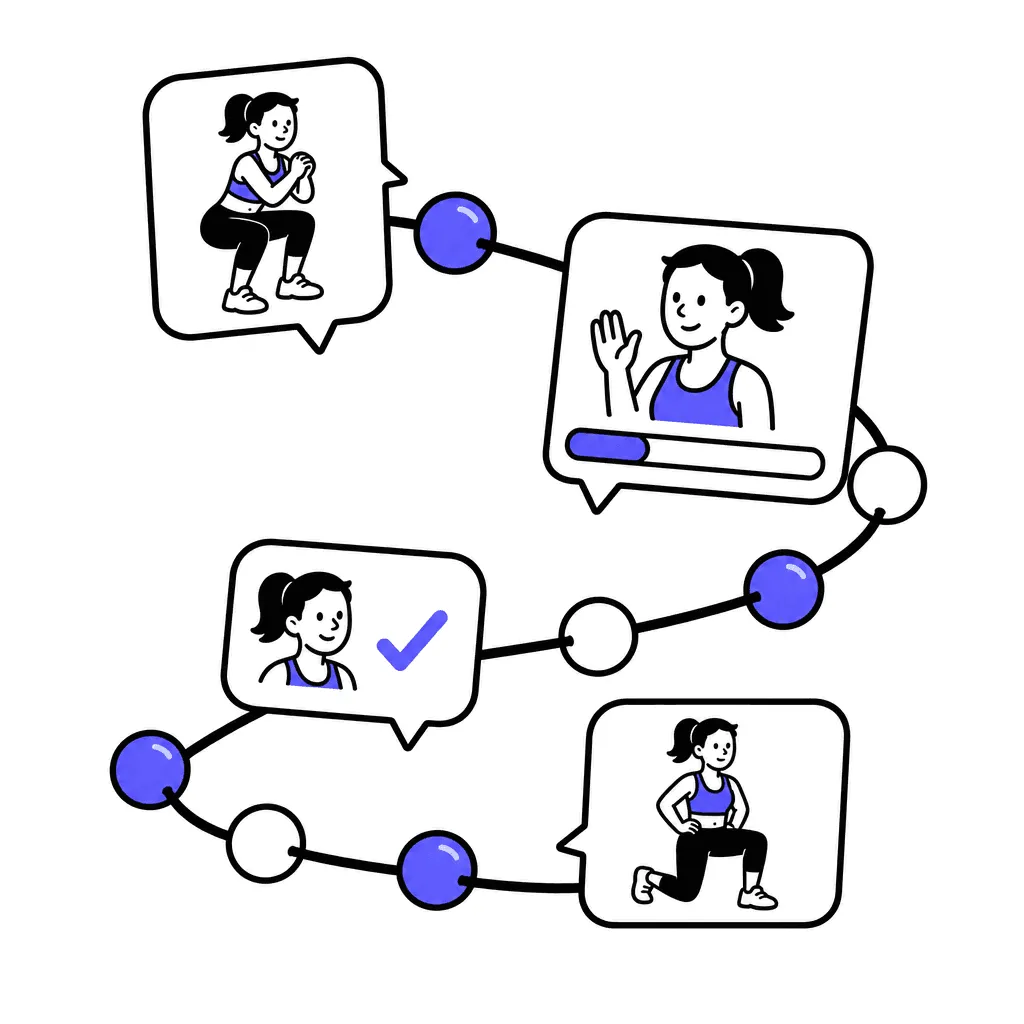
The alternative is structural, not heroic: the exercise itself is the conversation. Client finishes bench press → logs the sets → attaches a 20-second video of the last set → writes “elbow position felt off.” You see it that evening, answer on that exercise — one cue, one adjustment, done in ninety seconds. Thursday's session applies it. The thread lives with the exercise, so next month's “same elbow thing again?” has the whole history attached — not buried in page 40 of a chat scroll.
What this converts your role into: dozens of tiny, high-precision touches instead of one weekly essay. Practitioners consistently describe this as more connection in less time — and it's precisely the accountability texture (“clients feel held without feeling watched”) that the retention chapter says clients actually pay for.
Full disclosure, and the bar
The platform publishing this handbook is built around exactly this model — results and technique videos attach to the exercise, the coach answers there, and the exercise chat runs continuously across all of a client's workouts. But the principle outlives any tool, so the bar for whatever you use: can your client attach evidence to the work itself, and does your answer land where the work happened? If feedback lives in a general chat, you're running the Sunday ritual with extra steps.
What replaces the weekly summary
Not nothing — rhythm still matters. What changes is the content: with the details handled on the rep all week, a light weekly touch becomes strategy, not triage. Two sentences on the week's trend, next week's focus, one genuine acknowledgment. Five minutes, because the real coaching already happened where the work was. (Boundaries on all this — response windows, “not at 11pm” — are the next chapter, and they're what makes continuous feedback sustainable instead of infinite.)

What not to do
- Don't promise instant replies. Continuous ≠ immediate. “Within 24h on weekdays” is continuous enough and survivable forever.
- Don't give feedback on everything. A checkmark day deserves a checkmark. Save words for what changes something — noise trains clients to skip your messages.
- Don't let video review become film school. One cue per video. The second-best cue waits for next week.
- Don't run rep-level feedback through a general chat app. Context dies in the scroll; three weeks in, nobody can find the squat conversation. Structure is the product.
FAQ
Doesn't this take more of my time overall?
Measured coaches report the opposite: many 90-second contextual answers replace hours of Sunday reconstruction — and the capacity chapter's math assumes exactly this model.
What about clients who never attach anything?
That's an onboarding gap, not a personality trait — reinstall the habit. If it persists, it's the early-warning signal the ghost chapter is about.
Do I still need a monthly review?
Yes — strategy monthly, details on the rep, light touch weekly. Three layers, all cheap.
Voice notes or text?
Whichever you'll actually do consistently. Voice carries warmth and speed; text is searchable. Many coaches: text on the exercise, voice for the weekly touch.
Previous: Onboarding: the first 30 days · Next: Boundaries: you're not a 24/7 vending machine