The Online Fitness Coach Handbook
How much to charge
Updated September 2026 · 9 min read
The short version. Most online fitness coaches in the English-speaking market charge $150–300 a month for 1:1 coaching, and “monthly, not per session” is settled practitioner consensus. Most new coaches price from fear and undershoot badly. Pick a founding rate inside the market band, never free, and plan your first raise before you need it.
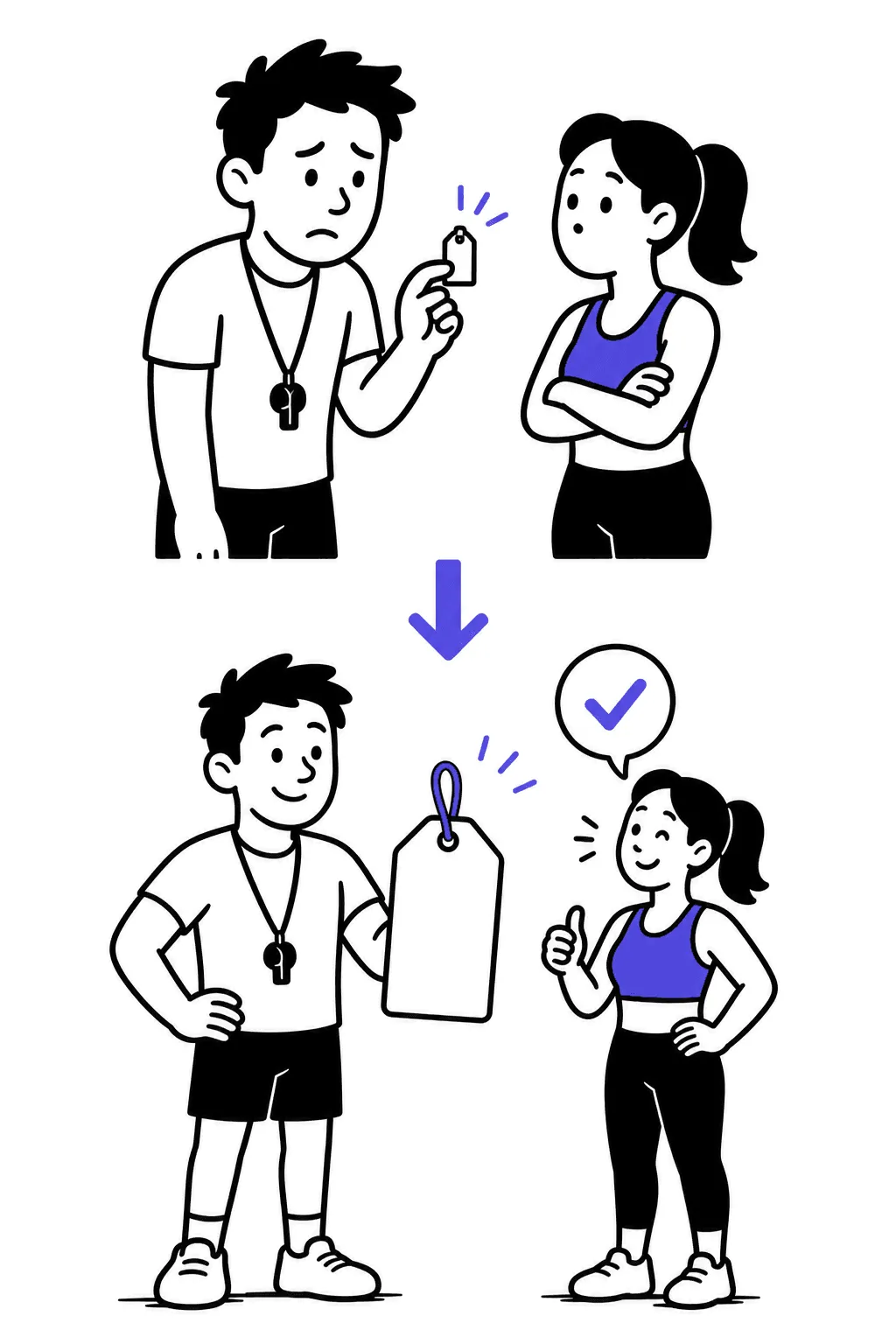
Fear pricing, named
“You default to fear-based pricing. You charge what feels ‘safe’.”
Fear pricing feels humble; it reads as a signal. At $50/month, prospects don't think “bargain” — they think “why so cheap?” The community is blunter:
“$50/month — you're cooked.”
Underpricing also books your calendar solid with clients who each pay a fraction of sustainable, which is how coaches end up fully booked and broke — the feast-or-famine loop with extra steps.
The anchors, honestly
What the market actually reports: $150–300/month is the normal band for real 1:1 online coaching (“I charge $199/mo… I've seen $99 to $750”). Where you sit inside the band is mostly three dials:
- Proof — years, results, the population you handle (your positioning paragraph, cashed in).
- Depth of service — response windows, how individualized, hybrid session included or not.
- Niche economics — what your specific people are used to paying to fix this problem.
What each format usually costs
The band above is for full 1:1 coaching. Less attention costs less, more live time costs more:
| Format | Typical price |
|---|---|
| Programming only A plan in an app, no check‑ins | $50–150/mo |
| Group coaching Shared program, group feedback | around $100/mo |
| 1:1 online coaching Custom plan, weekly check‑ins, messaging | $150–300/mo |
| Hybrid or live video Online plus in-person or live sessions (how to choose) | $200–600/mo |
Monthly, not per session
Per-session pricing imports the floor's worst property — income tied to attendance — into a business whose whole point is continuity. Monthly retainers price the service (programming, feedback, attention between workouts), smooth your revenue, and quietly filter for committed clients. Every experienced voice lands here; the disagreements are only about the number.
The founding rate
Your first five online clients get a founding rate: real money, openly framed. “I'm launching online coaching — first five people get $X/month locked for six months in exchange for honest feedback and, if it earns it, a testimonial.” Two rules make it work:
- Never free. “Free clients don't behave like clients” — they ghost check-ins, skip programs, and teach you nothing except how to chase. Discounted-and-invested beats free-and-absent every time.
- Time-boxed, not permanent. Founding means early, not forever. Lock the rate for a defined period so raising later is a calendar event, not a betrayal.
What not to do
- Don't price by dividing your gym rate. Online isn't a discounted session; it's a different product with more attention in it, not less.
- Don't publish a price you flinch saying out loud. Practice “It's $220 a month” until it's boring. Flinching costs more than the number.
- Don't compete on price. The coach $40 cheaper isn't your competitor; the invisible coach is.
- Don't believe your own napkin math either. 20 clients × $250 on a napkin is a ceiling, not a plan — churn, pauses and life exist.
FAQ
How much does online fitness coaching cost per month?
For 1:1 coaching with a custom plan and weekly check-ins, usually $150–300 a month in the US, UK, Canada and Australia. Programming-only apps run lower, around $50–150; hybrid coaching with in-person or live sessions runs higher, around $200–600.
What if my niche genuinely can't pay $150+?
Then it's a niche for group products someday, not for 1:1 coaching now — or your niche definition is hiding the buyers. Revisit the excavation before you discount the craft.
When do I raise prices?
New clients: whenever demand says so. Existing: with notice, honestly, rarely — there's a whole chapter on it in Growing.
Do I show the price publicly?
Practitioner split. Reasonable default: state the band (“from $200/month”) so strangers self-qualify, keep the exact quote for the conversation — where you can match it to the offer.
Previous: Your offer · Next: Filming your exercise library