The Online Fitness Coach Handbook
“It's too expensive” and friends
Updated August 2026 · 8 min read
The short version. Four objections cover almost everything: money, time, “I'll ask my spouse”, and “I can do it on my own”. The honest playbook has one move for all of them — isolate what's actually being said, answer it plainly, and accept real answers with grace. No wrestling. The dojos that teach comeback-scripts for each objection are training you to lose clients politely later.
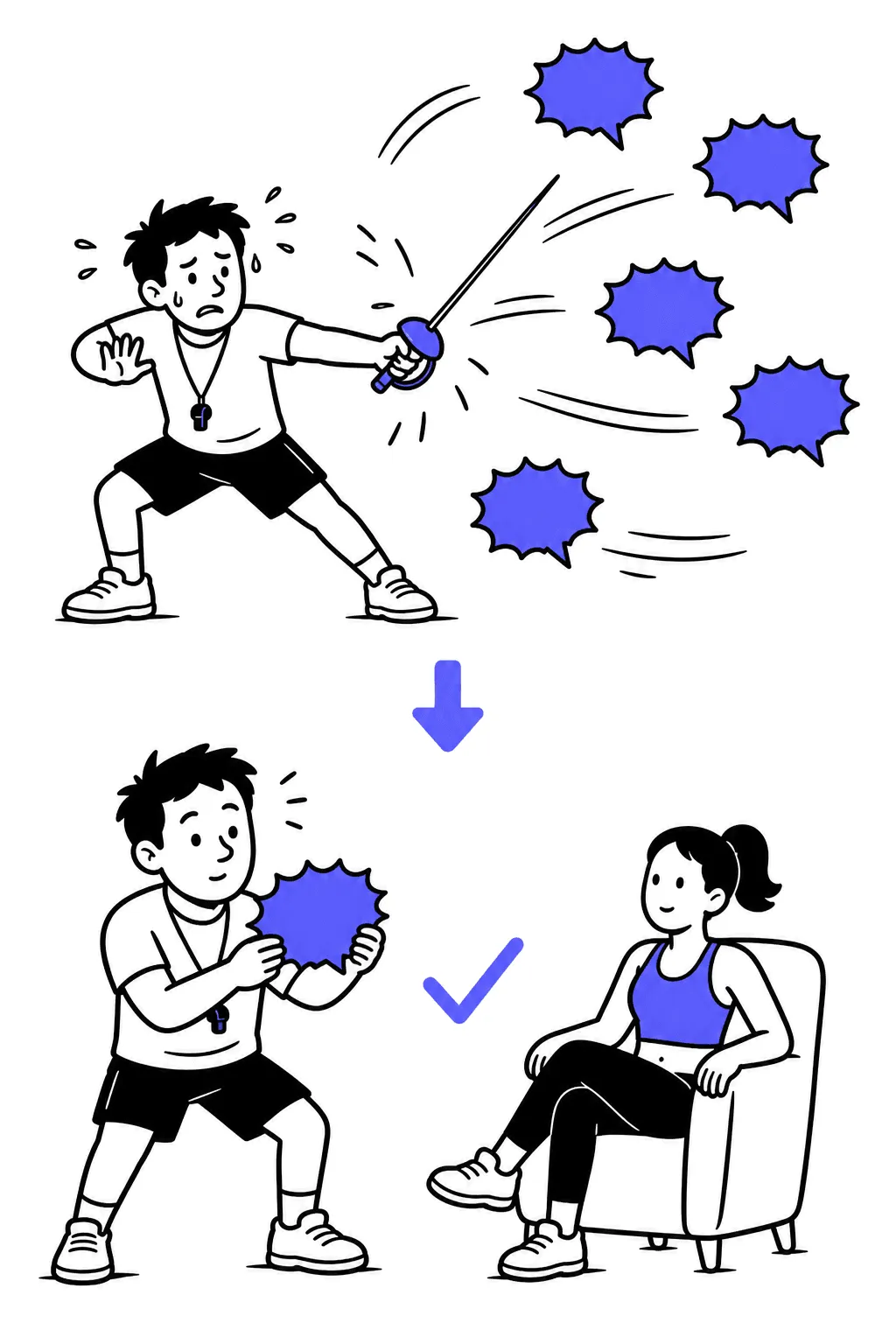
The big four, and what they actually mean
“The four big ones are spouse, money, time and ‘I can do this on my own’… Ask good questions, objections either disappear or are extremely easy to work through.”
The craft is knowing that each objection is usually a costume:
- “Too expensive” is sometimes about money — and often about unproven value or plain surprise (which transparent pricing upstream prevents). The research's sharpest distinction: “There's a big difference between ‘oh wow, I didn't expect you to be so expensive’ and ‘I would like to work with you, but the price is a little higher than what I'm comfortable paying’.” Different sentences, different answers.
- “I need to think about it” is almost never about thinking. Proof from the field: “I've even asked, ‘if this was for $35, would you go for it?’ They still said ‘I have to think about it’.” It's an unasked question wearing a delay.
- “I'll ask my spouse” is sometimes real family finance — and sometimes a polite exit. Both deserve respect; neither deserves the gross script (more below).
- “I can do it on my own” is true! They can. The honest answer is what coaching adds: the noticing, the adjusting, the not-quitting-in-week-three — the accountability the whole delivery part of this book is about.
The one move: isolate, then answer
The practitioner-standard response to “I need to think about it”, verbatim:
“That's actually a smoke screen. You can respond and ask: ‘Understood. May I ask, what is it that you have to think about? Just want to make sure I fully understand your situation.’ After saying that, do not speak… even if both of you are in 5 seconds of silence.”
The shorter version from the sales-craft school: “Ask them what they need to think about and be quiet.” The silence isn't a pressure tactic — it's space for the real question to surface. Then you answer that question, plainly, once.
For genuine money constraints, the honest tool is the structured downsell, not the discount: “ask them if the problem is the money due today… or the monthly cost… Your client may only train with you 1x per week rather than 3x… but you still have a client.” A lighter tier at full integrity beats a discounted full tier every time — discounts teach that your price was fiction.

The line you don't cross
The industry's objection-handling dojos teach scripts our research caught verbatim — and practitioners despise:
“I was told that if they said ‘I need to talk to my husband/wife before I buy’ to respond with… ‘do you have to ask your spouse for everything you buy for yourself?’”
That script — and its cousins (“let's calculate what you spend on coffee”) — closes a few deals and poisons a reputation. Your anti-guru audience has read the same threads you have; they know the scripts. The trust move is the opposite: “Talk it over — that's exactly what I'd do. Want me to send the one-pager so you're discussing the real thing?” Respect converts later even when it doesn't convert today.
And the boundary on your side of the table: know your walk-away. “No amount of ‘showing my value’ will turn someone who thinks $50 a session is costly onto my $85 rate. Instead, focus on the type of clients we attract” — the objection you hear every week is often a targeting problem wearing a sales costume.

What not to do
- Don't rebut instantly. The instant comeback says “I wasn't listening, I was reloading.” Isolate first, always.
- Don't discount under pressure. A price that bends under a frown was never a price. Downsell structure, never integrity.
- Don't weaponize their insecurities. Guilt about health, fear of aging, spousal dynamics — the gurus' fuel, your poison.
- Don't treat rejection as a verdict. “Rejection is normal. Doesn't mean you're bad at your job” — verbatim, from a working coach. Some nos are timing; the list keeps the door lit.
FAQ
What if the objection comes by text, not on a call?
Same move, slower medium: “Fair — what's the main thing you're weighing?” One isolating question per message, then patience.
Someone ghosts after “sounds great!” — is that an objection?
It's the objection they didn't want to say out loud. One warm nudge, then the dormant-lead treatment from the list chapter. Chasing converts nothing.
Should I have written FAQ/objection answers on my page?
Yes — the door chapter's transparency is objection-proofing at scale: price band, what's included, how starting works. Every pre-answered question is a call that doesn't stall.
When is “too expensive” actually true for my market?
When your three-for-three niche clients — the ones who love the work — consistently say it. That's pricing feedback, not an objection; revisit the pricing chapter's dials.
Previous: The sales call · Next: Free, trial, beta: value without giving yourself away