The Online Fitness Coach Handbook
Burnout-proofing the solo business
Updated August 2026 · 8 min read
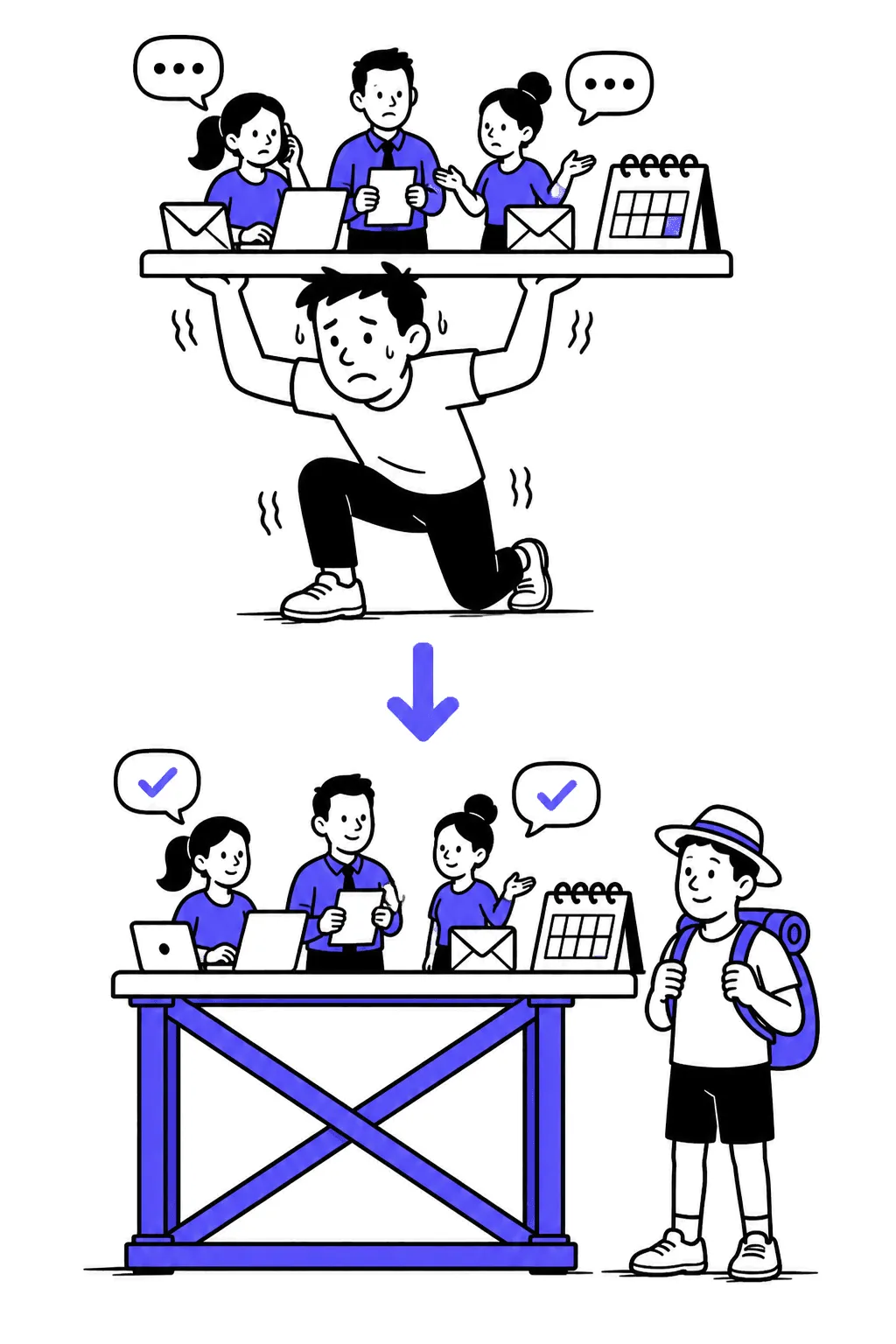
The short version. The solo coach's real single point of failure isn't churn or algorithms — it's you. Burnout-proofing is infrastructure, built in calm times: real vacations with a client protocol, a sick-day playbook, workload honesty, and the early-warning signals taken seriously. The business exists so you can coach for decades — not so coaching can consume you in three years.
The occupational hazard nobody budgets
The corpus began this book with a coach whose “body is cooked” from thirty-five floor sessions a week. Online coaching removes the physical grind and quietly substitutes an emotional one: always-in-pocket clients, no closing time, work that follows you to bed in an app. The 24/7 burnout quote from the boundaries chapter — “will burn you out in 3 months flat” — was about messages; this chapter is about the year scale. Practitioners who leave the industry describe the same arc: not one crisis, but the slow evaporation of margin — until a small bad week became the last one.
The reframe: margin is not slack — margin is the product's shelf life. A coach with reserves notices clients (the entire value proposition); a depleted coach runs scripts and gets slowly detected. Everything in this chapter protects the noticing.
The vacation protocol
Yes, a solo coach can vacation — with the pause-chapter machinery pointed at yourself:
- Announce early, frame confidently. Three-plus weeks notice, no apology: “I'm offline July 1–14. Here's exactly how your training continues.” Clients mirror your calm; boundaries taught them how.
- Pre-load the fortnight. Programs assigned ahead, deliberately familiar — vacation weeks are consolidation blocks, not experiments needing feedback.
- Define the silence honestly. “Logging works as always; I'm answering nothing until the 15th, then I'll review everything” beats a fictional “limited availability” that becomes full availability from a beach.
- The systems hold the fort: billing runs itself, the missed-workout triggers queue quietly, the emergency lane (injury → stop, message, I'll see it first) stays declared.
- Re-entry is a real workday: reviewing the fortnight's logs and writing everyone a personal two-liner — the “welcome back” touch that turns your absence into proof the system works.
Twice a year minimum. The first one is terrifying and loses precisely nobody — the near-universal practitioner report.

Sick days, life weeks, and the honest workload
- The sick-day playbook, pre-written: one message template (“under the weather — reviews tomorrow evening”), triggers keep watch, nothing else moves. Deciding this while healthy costs nothing; deciding it mid-fever costs credibility.
- Life weeks — yours happen too: the deadline season, the family crisis. The ghost-chapter mercy applies to coaches: shrink your own week (weekly touches only, feedback batched) instead of silently failing at full spec. Clients survive an honest light-mode fortnight far better than a frayed coach.
- Workload honesty is quarterly maintenance: the capacity buffer restored (it erodes), one Friday-numbers question extended — “am I dreading anything?” Dread anywhere in the system is the earliest burnout signal on record, and it always names its cause: a client, a task, a number.
And the un-glamorous foundation the whole industry forgets: you train, you sleep, you have non-coaching life — on the calendar, defended like client sessions. A coach who visibly lives the product is marketing; a coach who doesn't is a countdown.

What not to do
- Don't wear exhaustion as proof of care. Clients don't want your Sundays; they want your attention on Tuesday. Martyrdom converts to resentment on a schedule.
- Don't skip vacations “because solo”. Solo is why the protocol exists. The business that can't survive your fortnight isn't a business yet — it's a job with extra steps, and the systems chapters are the fix.
- Don't hide struggle behind fake polish. You needn't broadcast burnout, but “lighter week on my end — reviews land Thursday” is professional honesty, not weakness.
- Don't wait for the crash to take the signals seriously. Dread, Sunday-creep, template-feeling touches — two signals, one deliberate margin-restoring move. The book's own 48-hour rule, self-applied.
FAQ
What if a client quits over my vacation?
Then the vacation surfaced a mismatch the boundaries chapter would have met eventually. In practitioner experience it's rare to the point of legend — and the roster that remains respects you more.
Realistic max weeks off per year for a solo coach?
Four to six, split across the year, runs comfortably on the protocol. More is possible with longer pre-loads; the constraint is programming ahead, not client patience.
I'm already burnt out. Where do I start?
Triage order: boundaries tonight (windows, phone-drawer), one automation this week (billing or triggers), workload honesty Friday (shrink to demonstrated capacity), vacation on the calendar this month. Then read the book's systems chapters in order — burnout is usually five missing systems wearing one exhausted face.
Does taking breaks damage the “always there” promise?
You never made that promise — the offer chapter made a better one: reliable, boundaried, excellent. Breaks kept visibly and professionally fulfill it.
Previous: The numbers that matter