The Online Fitness Coach Handbook
How many clients you can actually handle
Updated August 2026 · 9 min read
The short version. The internet answers “how many online clients can a coach handle?” with numbers from 20 to 80, all confidently wrong for you — because capacity isn't a number, it's an equation: your weekly coaching hours ÷ real minutes per client. Do the arithmetic honestly (the calculator below does it with you) and you'll find your ceiling — then treat it as a design constraint, not a target to smash through.
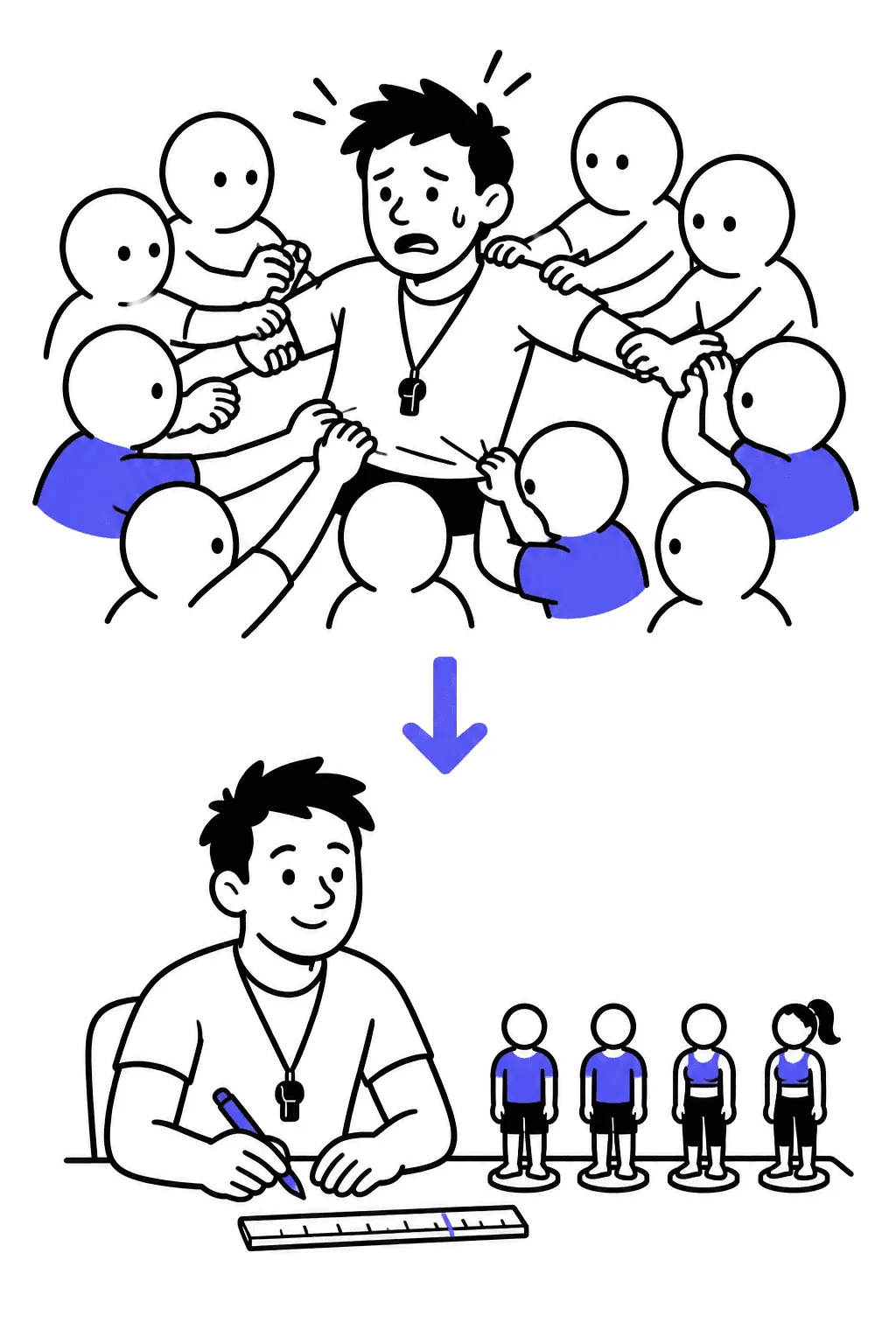
The arithmetic rebellion
“5min check-in with 100 clients is more than 8 hours of work per day just on check-ins.”
That sentence killed a thousand “scale to 100 clients” fantasies. The honest version has only three variables:
- Hours per week you'll actually coach — the focused hours for programming, feedback and reviews, after your own training, family, and the admin the systems chapter automates.
- Real minutes per client per week — programming updates + feedback on their logged work + the weekly touch + monthly review, averaged. With feedback on the rep and templates-as-starting-points, practitioners land at 20–40 minutes; deep-individualization styles run 60+. Time yourself for one honest week; guessing flatters everyone.
- The buffer — onboarding is front-loaded, someone's always in a comeback week, and life eats Tuesdays. Plan at 80% of theoretical max; the coaches at 100% are the burnout statistics.
Capacity is a design decision
Every variable is adjustable by design, not by suffering:
- Raise hours? Only by protecting them — the boundaries chapter's windows are literally capacity infrastructure.
- Lower minutes-per-client? Systems, not corner-cutting: feedback on the rep, program templates as starting points, automation of the admin layer.
- Or don't grow the number at all — raise the price instead. Fifteen clients at $260 equals twenty at $195, with five fewer humans' worth of attention debt. The full-books chapter builds the whole endgame on this trade.
The number that matters isn't “how many CAN I handle” — it's “how many can I handle at the quality that justifies my price, for years, without hating Sundays.” That's the ceiling worth respecting.

What not to do
- Don't take a roster number from a guru or this book. Take the equation. Your 22 is real; their 50 is marketing.
- Don't fill the buffer “temporarily”. The 80% margin is where real life gets absorbed. 100% booked is 110% delivered.
- Don't equate more clients with more profit. Past your systems' capacity, each new client silently taxes every existing one.
- Don't scale headcount before minutes-per-client is lean. Growth multiplies your inefficiencies faster than your income.
FAQ
So what's a typical solo ceiling, honestly?
With good systems and the async model: most quality-first solo coaches land somewhere between 15 and 30. But run your equation — depth of service moves it enormously.
Does hybrid change the math?
Yes — floor sessions consume hours fast. Count each weekly in-person client at their session length plus their online minutes; hybrids hit hour-limits before headcount-limits.
How do I know I'm past capacity?
The signals arrive in order: feedback latency stretches, the weekly touch becomes copy-paste, you dread specific names, Sunday reappears as a workday. Two of those = you're past it.
Is it rude to cap my roster?
It's the opposite — the cap is what your current clients' quality is made of. “I'm full — join the waitlist” is also the strongest marketing sentence in the book.
Previous: Getting paid without chasing · Next: Systems: automate the admin, never the wins