The Online Fitness Coach Handbook
Full books: the solo endgame
Updated August 2026 · 8 min read
The short version. The industry says a full roster is a growth problem you solve with hiring, group programs and “scaling”. This book says a full roster is the win condition — if you build the endgame deliberately: a real waitlist, client selection, price as the regulator, and depth over headcount. Small, full, profitable and calm is not a consolation prize. It's the point.
The fork the industry hides
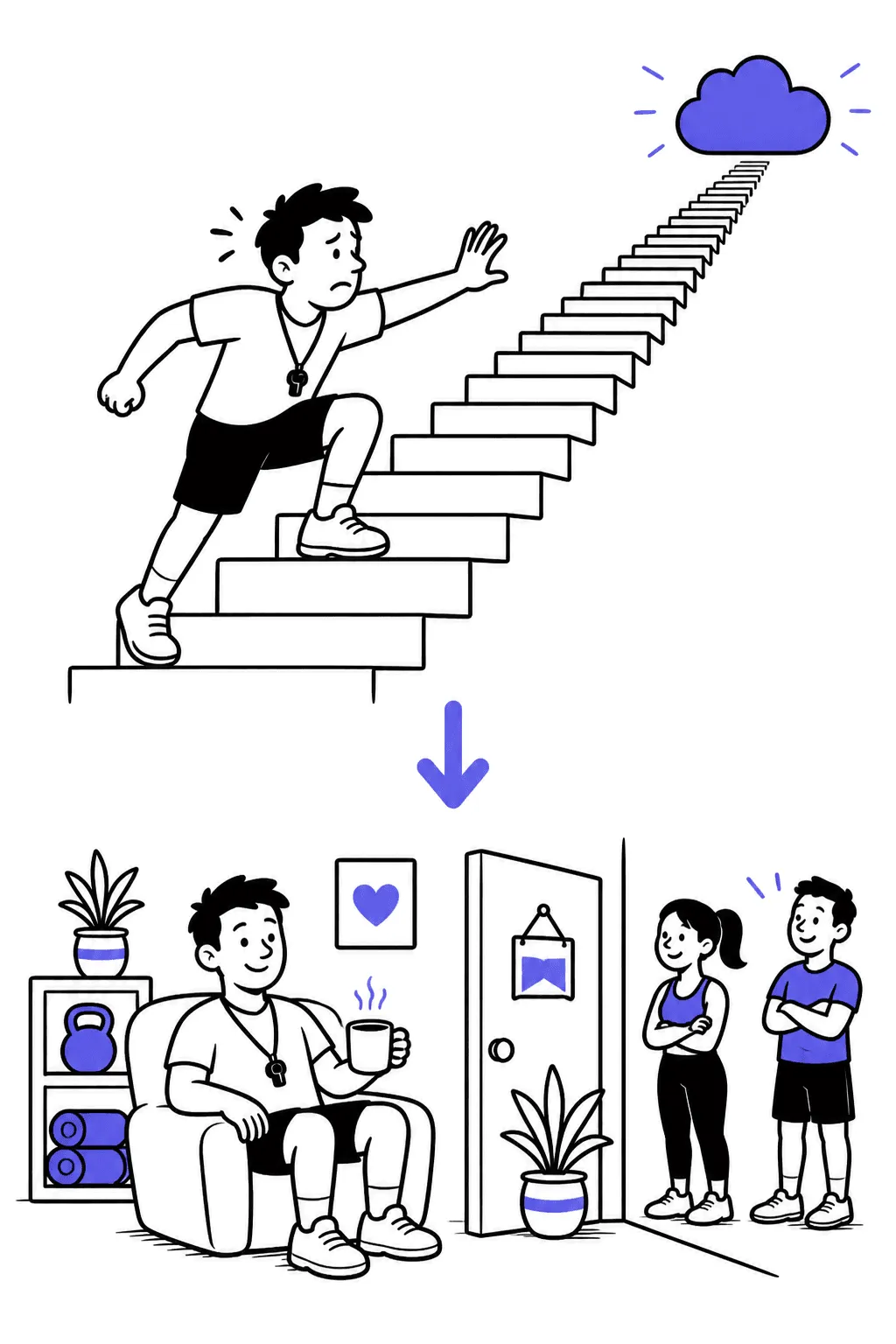
At a full roster, every mentor and platform pushes the same door: hire coaches, launch a group program, “leverage yourself”. Those are real businesses — different businesses, with management, marketing-at-scale, and someone else coaching your clients. This book drew its boundary in the very first chapters: solo, 1:1, hybrid. So what does growth mean when headcount is capped by design?
Three dials remain, and they're better than the fourth:
- Price — the previous chapter. The full-roster coach raises the new-client dial until demand and capacity kiss.
- Depth — richer service to the same humans: hybrid add-ons, quarterly in-person assessments, longer retention. Depth raises value per client without adding clients.
- Selection — the quiet superpower of full: you choose. Three-for-three clients only (the niche excavation, now as a filter): people who get results, whom you enjoy, whom you'd take five more of.
Staying small on purpose has a chorus of practitioners behind it — the company-of-one philosophy they keep rediscovering: growth in quality, income and freedom, with headcount flat by design.
The waitlist, done properly
“I'm full” without a waitlist is turnover waiting to hurt; with one, it's compounding demand. The mechanics:
- A real list, not a vibe. Name, contact, what they're looking for, when they asked. The door switches from “start now” to “join the waitlist” — an application form doubling as the filter.
- Tended like the list chapter taught: a note when they join (“you're fourth in line — typically a spot opens every month or two”), a touch when they move up, honesty if timing changes. A tended waitlist holds warm for months; an ignored one evaporates in weeks.
- Spot-opening protocol: offer to the top match (not strictly the top of the queue — fit beats order, and you say so upfront), 48 hours to decide, then next. Scarcity with kindness, never scarcity theater.
- And the sentence itself sells. “I'm full — waitlist is open” is simultaneously true, humble, and the strongest positioning line in the book. Fully booked is proof no testimonial can match.

Turnover, the calm way
Full-book solo coaching has a natural rhythm the scale-obsessed never learn: one or two spots turn over per quarter — a graduation, a move, a pause that becomes goodbye. With a tended waitlist, each opening fills in days at the current new-client price. Churn stops being a fear and becomes the mechanism by which your average rate climbs without ever raising an existing client. The numbers-page view: roster flat, revenue gently up, hours flat, dread absent.

What not to do
- Don't hire “just an assistant coach” casually. That's the other business, entered through the back door — with payroll, quality control and a manager's calendar. If you want that business, choose it deliberately; this book's map ends at the border.
- Don't launch a course to “serve the waitlist”. The audience-business failure mode from the models chapter, resurrected by success. The waitlist wants you; a PDF of you is a refund pattern.
- Don't keep a secret waitlist. Untold, it helps nobody: say the sentence publicly. The door should show it.
- Don't confuse full with finished. Full books is a state to maintain — the retention, referral and pricing systems keep running; they're what full is made of.
FAQ
How long can a solo coach realistically stay full?
Practitioner examples run years to decades — the model's stability is the appeal. The maintenance costs are the boring ones: boundaries held, systems running, prices reviewed annually.
Should waitlist people get anything while waiting?
The list-chapter treatment: occasional useful notes, honest timing updates. Some coaches offer the trial workout as a waitlist perk — a taste that holds warmth without consuming coaching hours.
What if the waitlist grows to twenty?
That's the price dial screaming. Raise the new-client rate until the list shortens to a healthy handful — the queue length is literally your price-discovery instrument.
Isn't refusing growth leaving money on the table?
Run both futures in the numbers chapter: agency-you at 60 clients with two hires and management overhead vs full-solo-you at 22 deep clients at endgame rates. The table money is usually smaller than advertised — and it charges interest in Sundays.
Previous: Raising your prices · Next: Paid ads, eventually