

Why online coaching needs a tracking system
On the gym floor progress is visible. You watched the first squat and you watch today’s. Online you see only what the client sends you. A silent week can mean skipped sessions, or sessions that were done and never logged.
Decide at the start what each client records, how often, and where it lands. Then “is this working?” has an answer both of you can look at.
What I check every week and every month
Every week I check four things with each client: technique in the exercises, how they feel, how their muscles are recovering, and whether the planned workouts got done.
Once a month I add bodyweight and measurements and look at the overall progress. With some clients that check comes every six weeks instead: it depends on the case.
How long it takes is hard to count in minutes. I try to give each client at least an hour a week on a call: we talk, go through what was difficult, and with some we take an exercise apart. Checking technique is on top of that hour. I do it separately.
The seven signals
Each signal answers a different question.
| Signal | What it tells you | How often | Who records it |
|---|---|---|---|
| Technique | Whether the movement itself is getting better | Every week | The client films it, the coach reviews |
| Training numbers | Whether the client is getting stronger | Every session | The client, in the workout log |
| Plan completion | Whether the program fits their week | Every week | Nobody: it is counted from workouts marked done |
| How the client feels | Whether the load and the recovery are right | Every session and every week | The client: one tap per exercise, a few words a week |
| Bodyweight | The direction of weight over months | Once a month | The client |
| Body measurements | Changes in shape the scale misses | Once a month | The client, with a tape |
| Photos | Shape, posture and how the two sides compare | Once a month | The client, if they agree |
-
Technique
- What it tells you:
- Whether the movement itself is getting better
- How often:
- Every week
- Who records it:
- The client films it, the coach reviews
-
Training numbers
- What it tells you:
- Whether the client is getting stronger
- How often:
- Every session
- Who records it:
- The client, in the workout log
-
Plan completion
- What it tells you:
- Whether the program fits their week
- How often:
- Every week
- Who records it:
- Nobody: it is counted from workouts marked done
-
How the client feels
- What it tells you:
- Whether the load and the recovery are right
- How often:
- Every session and every week
- Who records it:
- The client: one tap per exercise, a few words a week
-
Bodyweight
- What it tells you:
- The direction of weight over months
- How often:
- Once a month
- Who records it:
- The client
-
Body measurements
- What it tells you:
- Changes in shape the scale misses
- How often:
- Once a month
- Who records it:
- The client, with a tape
-
Photos
- What it tells you:
- Shape, posture and how the two sides compare
- How often:
- Once a month
- Who records it:
- The client, if they agree
Not every client needs all seven. A fat-loss client usually needs plan completion, bodyweight and measurements. A strength client needs technique, training numbers and plan completion. Agree on the set during onboarding, so that nothing you ask for later comes as a surprise.
Record a baseline in the first week: starting weights in the main exercises, bodyweight, measurements and, if the client agrees, photos. Without it nothing later has a point of comparison.
Technique, training numbers and plan completion
Technique is the first thing I check every week. Numbers do not show how the lift looked, and the handbook chapter on feedback on the rep covers how to give that feedback.
Training numbers and plan completion come free with logging. When the client records sets and marks the workout done, you get weight and reps for every exercise, and you know which sessions happened.
Read completion first. If a client did 12 of 13 planned sessions in a month and stalled, look at the program. If they did 7 of 13, look at the schedule: no change to sets and reps will fix missed sessions.
Then look at weight and reps in each exercise across the last few weeks, not from one session to the next. More reps at the same weight is progress too. One bad session is noise. Three flat weeks in a lift that used to move is a signal. Judge each client against their own history: an experienced lifter moves slower than a beginner.
The screens in this article come from OnlineFitness.app, the app this site belongs to. They show a demo client, not a real person. You can run the same method from a spreadsheet. What matters is that both of you can see the trend without anyone compiling it by hand.
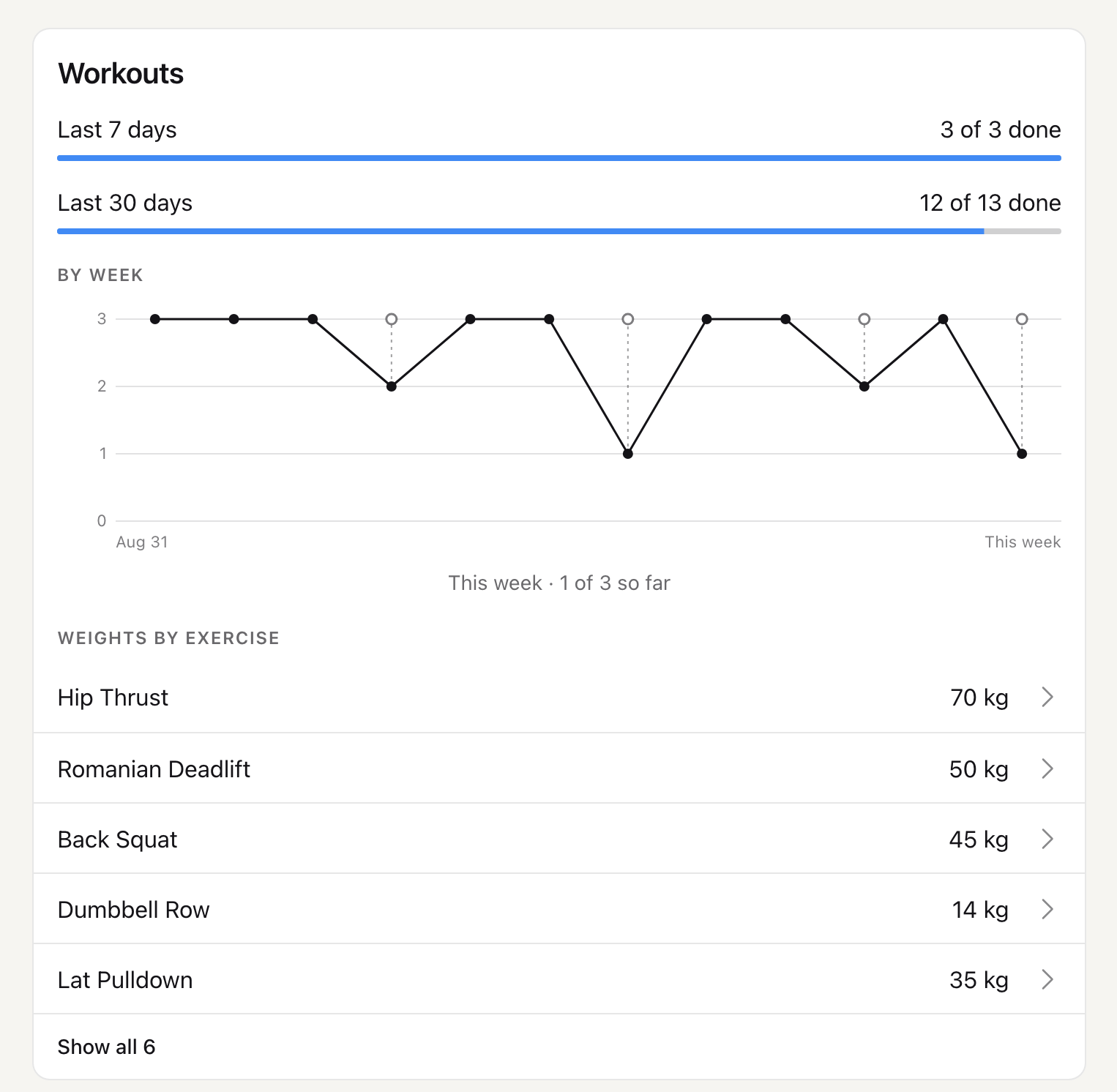
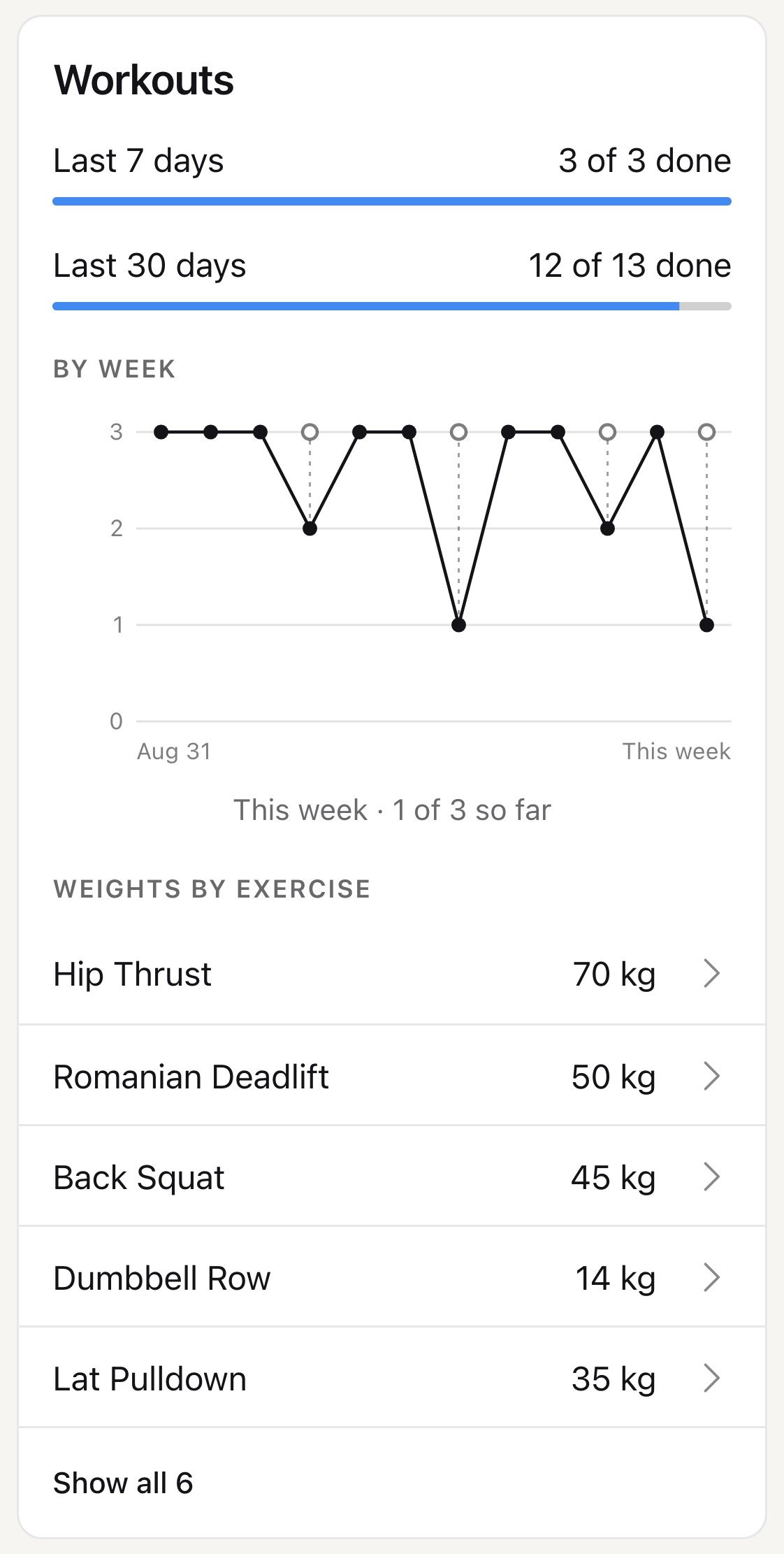
A client’s Progress page, as the coach sees it
- 1 Sessions done out of planned, for the last 7 and the last 30 days.
- 2 Up to twelve weeks at a glance. A hollow ring marks the plan in a week when the client did less.
- 3 The weight the client works with now in each exercise. A row opens the history of that exercise.
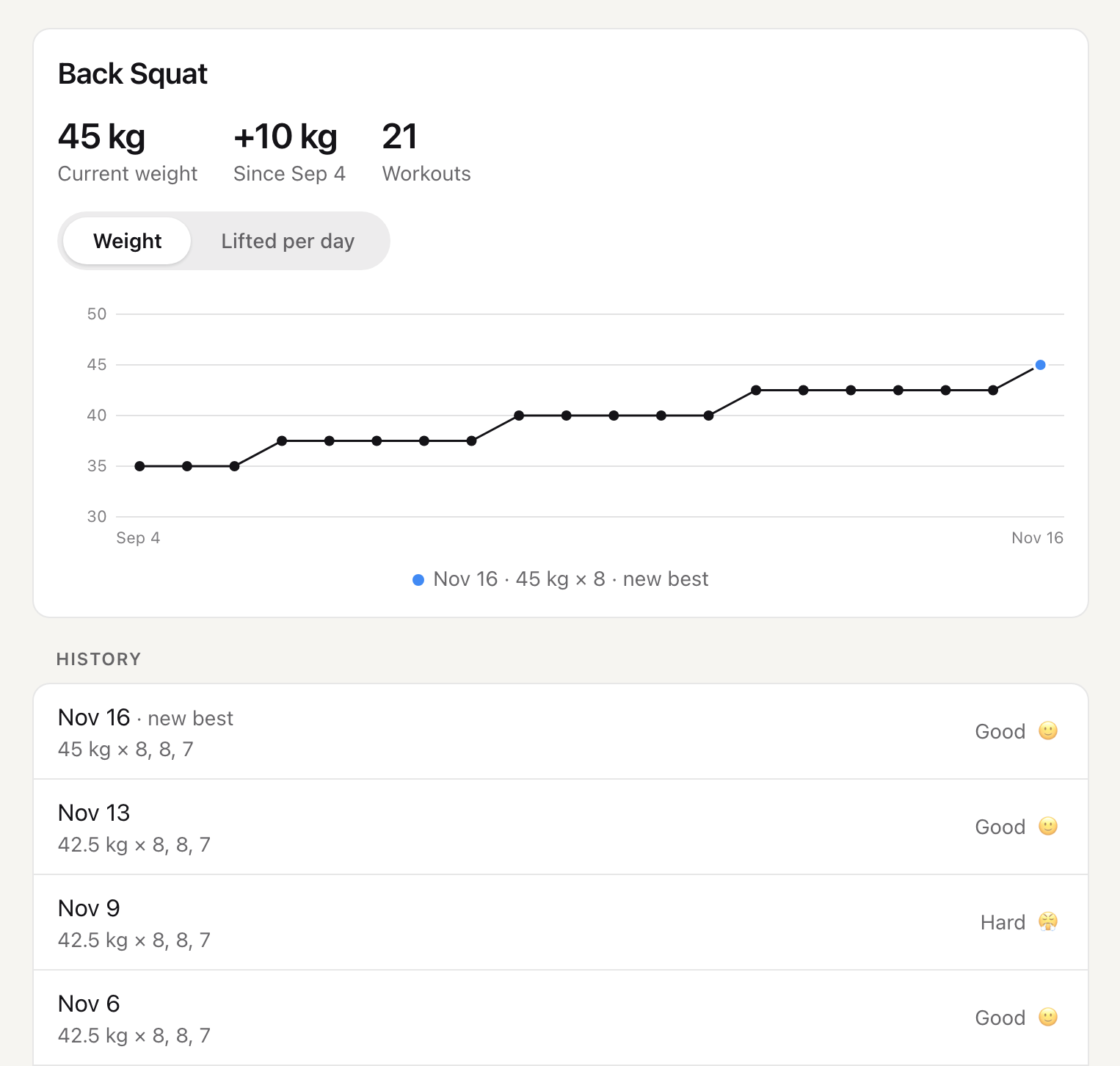
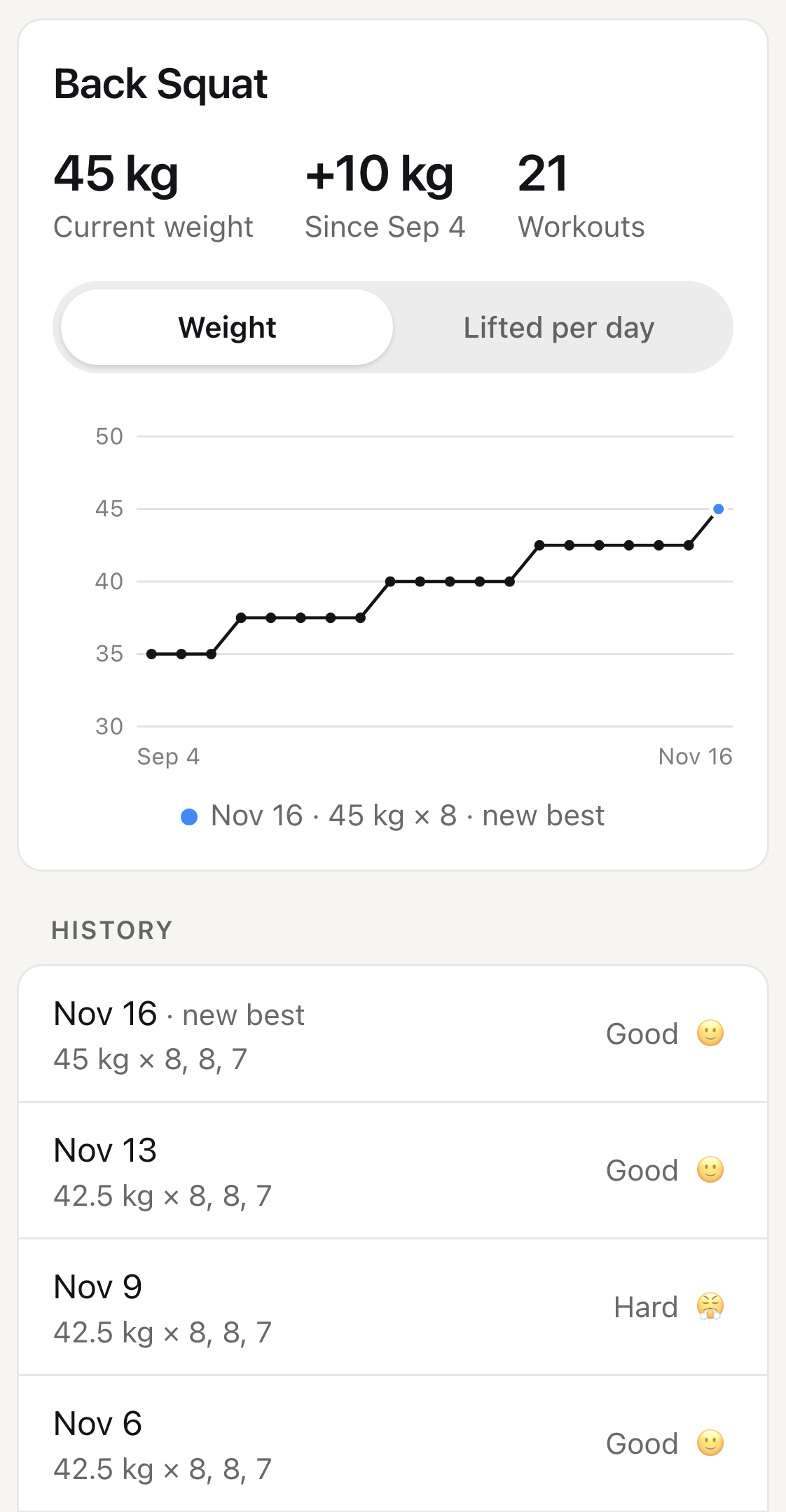
One exercise, opened from the list
- 1 The current weight and how much it has changed since the first day on the chart.
- 2 The heaviest set of each day. The blue point is the client’s best. A switch shows the total lifted per day instead.
- 3 The sets of every session, with how the client said the exercise felt.
How the client feels
Numbers say what was lifted. They do not say what it cost. Every week I ask each client how they feel and how their muscles are recovering.
Between those conversations, ask for one rating per exercise, right after the last set, on a short scale from “too easy” to “couldn’t do it”. One tap, no essay.
Act on single ratings quickly. When an exercise is “too easy” two sessions in a row, add weight or reps. Over a month the split shows where the load sits: mostly middle ratings with some “hard” is a program doing its job. More “hard” ratings at the same weights is a reason to ask about sleep, stress and food, and to plan one easier week.
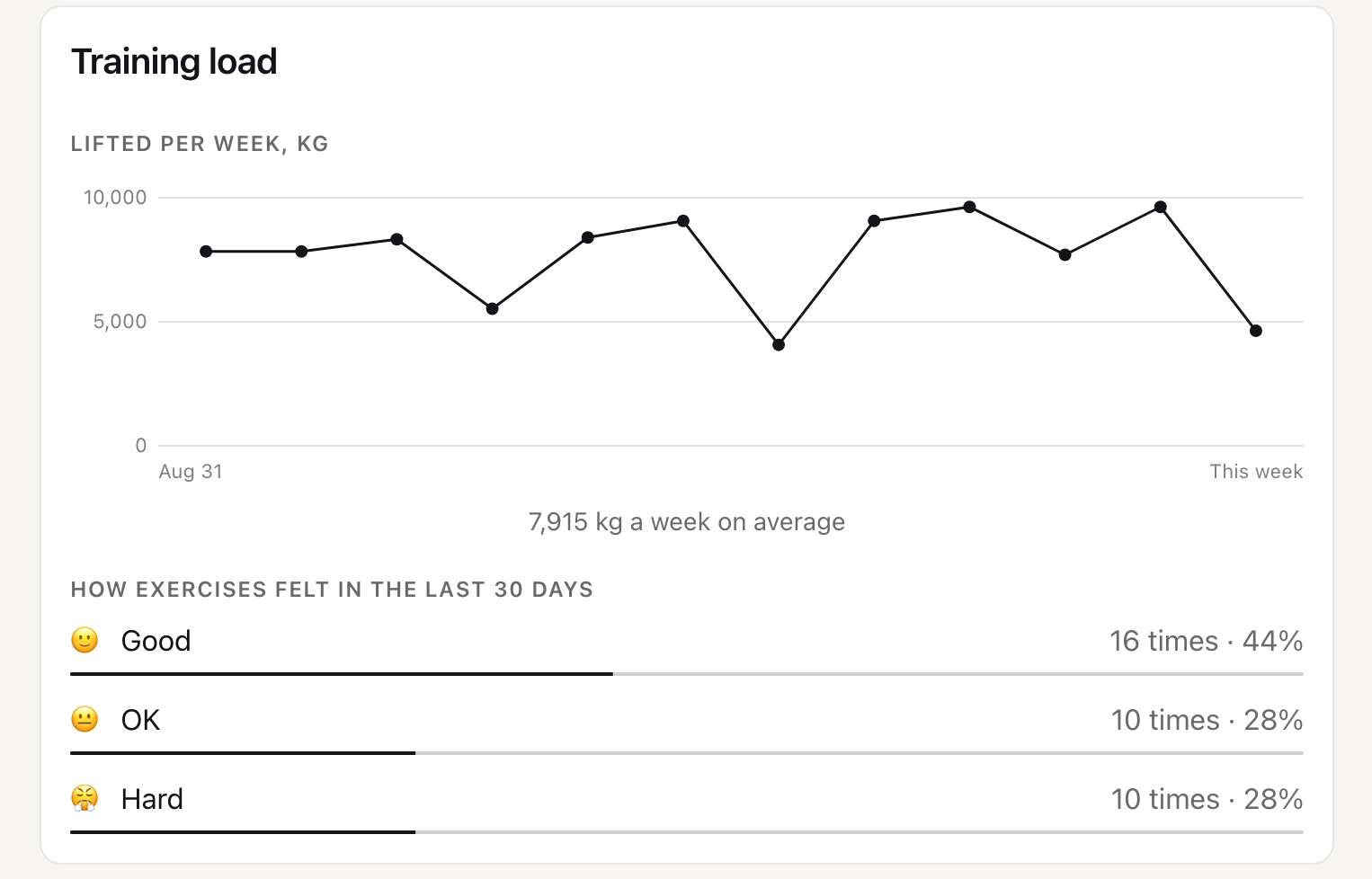
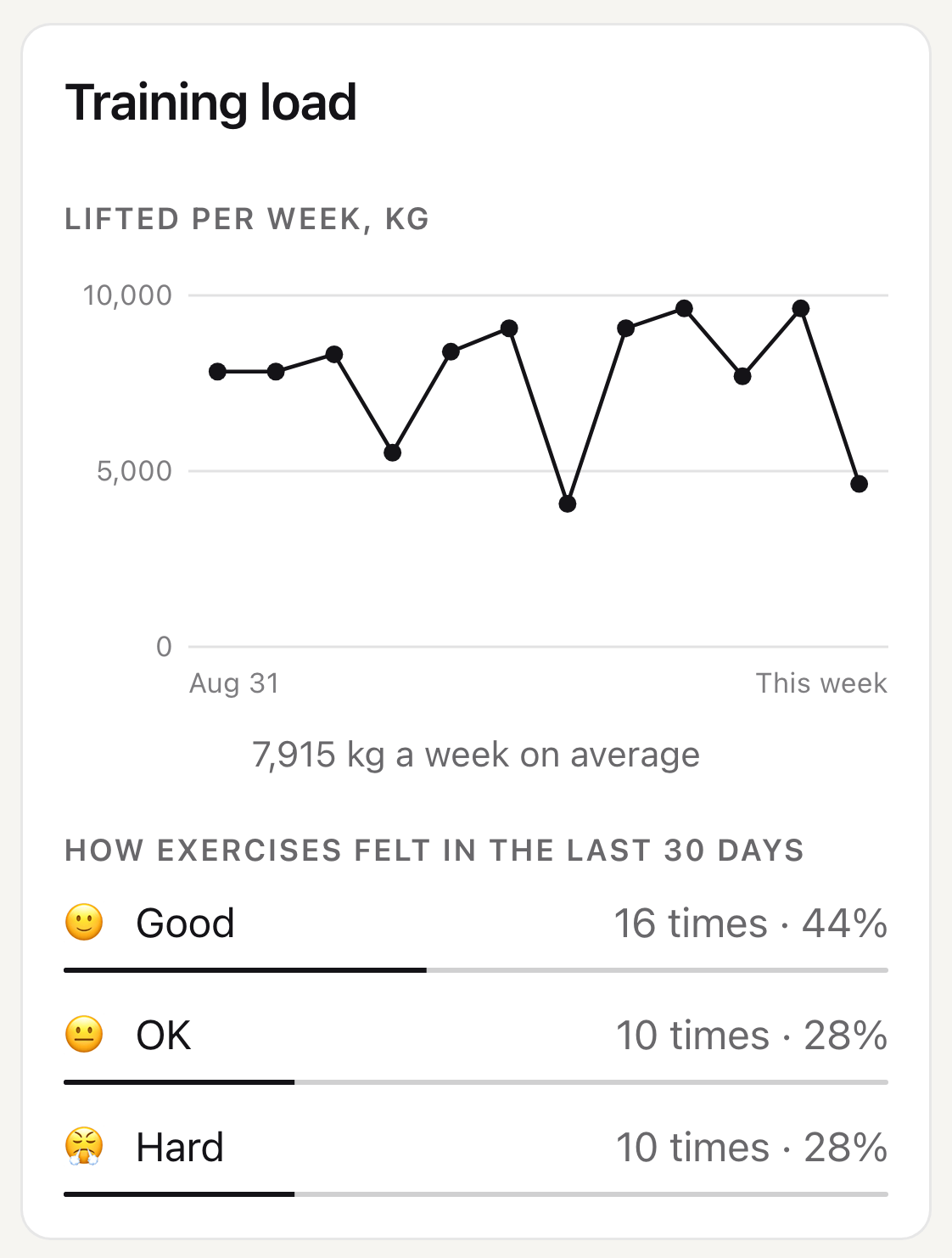
Training load on the same page
- 1 Everything the client lifted in a week, across all exercises, with the weekly average under the chart.
- 2 How the client rated exercises over the last 30 days, as shares of all ratings.
Bodyweight: once a month, unless weight is the goal
I weigh my clients once a month, together with the measurements, and with some every six weeks. Not every result is measured on the scale.
When bodyweight itself is the goal and the client wants to follow it closely, single weigh-ins mislead. Daily weight moves with salt, carbohydrates, sleep and the menstrual cycle. Ask for three or more weigh-ins a week under the same conditions: in the morning, after the bathroom, before food and drink. Compare this week’s average with last week’s. For a client with a menstrual cycle, compare the same week of the cycle from month to month.
Measurements and photos
The tape catches what the scale hides. Measure waist and hips once a month, at the same spots and the same time of day, with the tape snug but not tight. Add arms, chest or thighs when the goal calls for them.
I ask every client for photos. To those who feel shy I explain what the photos are for. Results are not only weight or a change in shape. In photos I also look at where the muscles stay too tense, how the right and left sides compare, and how the body responds to the load. That shows me what to emphasize next.
The protocol: same light, same place, same clothes, from the front, the back and both sides, once a month. The photos belong to the client.
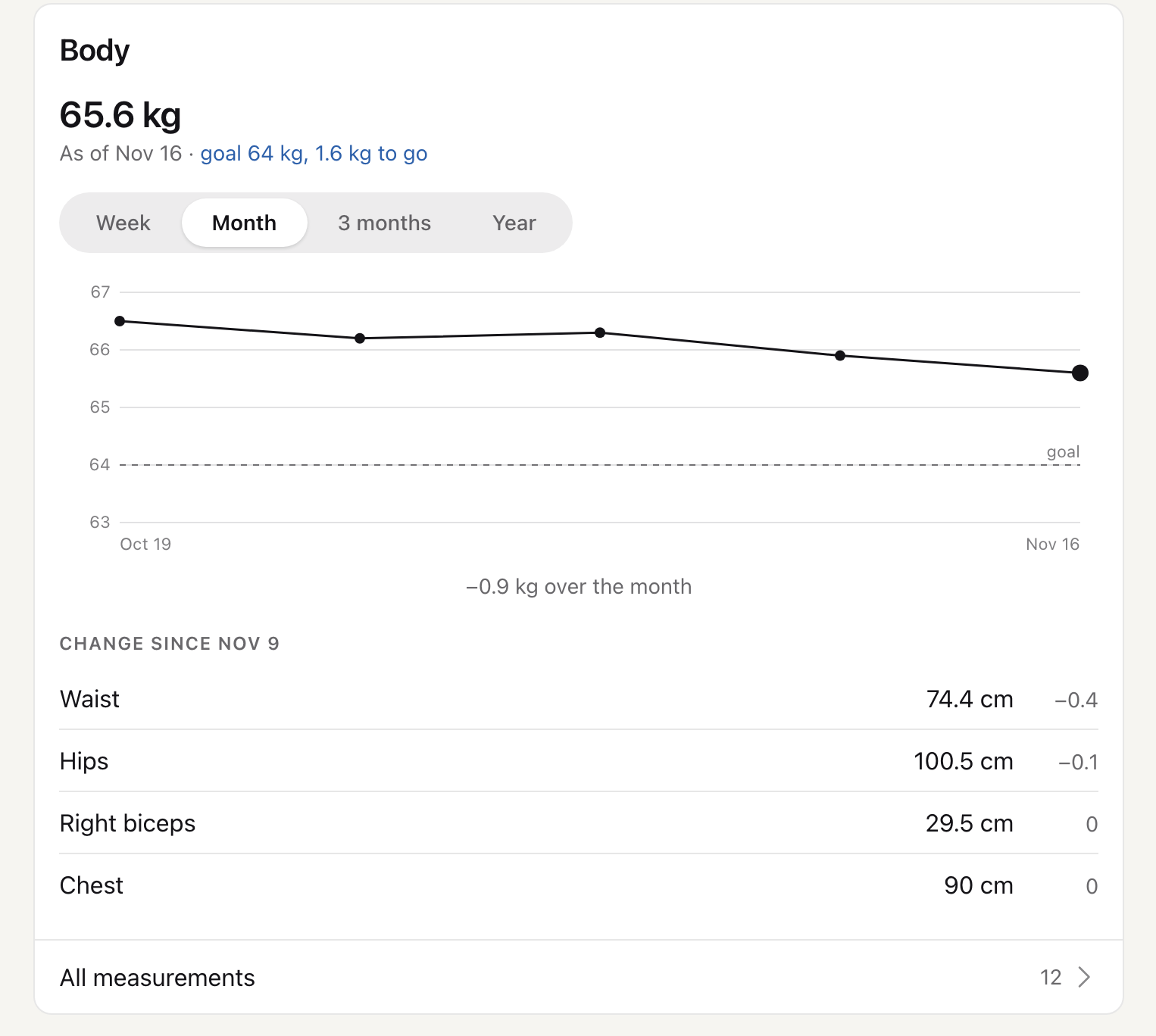
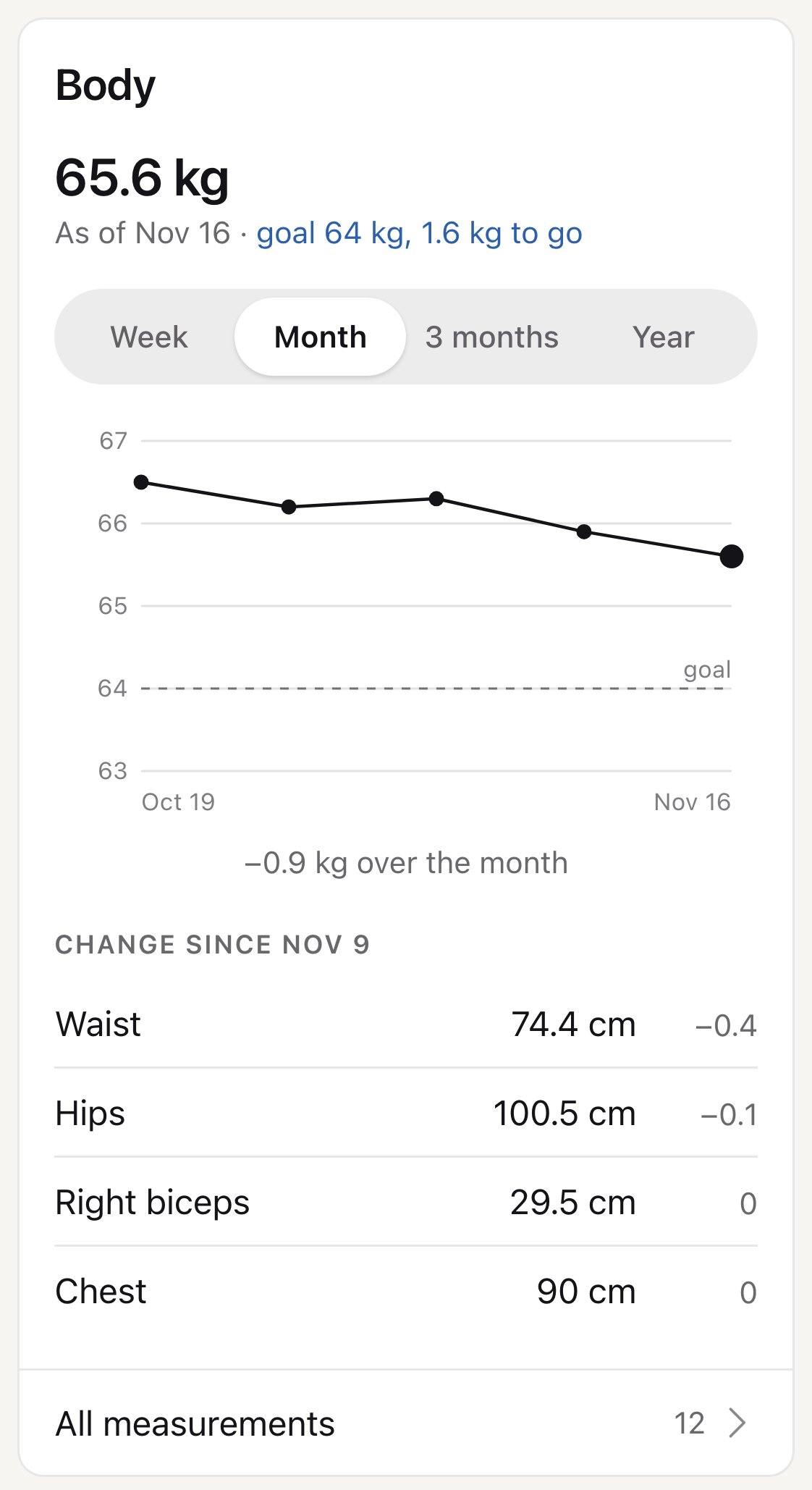
Body on the same page
- 1 The latest weight and the distance to the target weight the client set.
- 2 The trend for a week, a month, three months or a year.
- 3 Main measurements with the change since the previous entry, when both entries include them. The client adds weight, measurements and photos in their own app.
Read the signals together
It happens that bodyweight hardly moves, yet the measurements have changed and the client looks different. Posture changes too: there is less tension, the right and left sides even out, the neck comes back into line, the skin looks firmer. I have seen weight barely change while the visible change was very strong.
Five common combinations and what to do about each.
| What you see | What it usually means | What to do |
|---|---|---|
| Weight flat, waist down, lifts up | The body is changing shape | Change nothing. Show the client the tape and the lifts. |
| Fat-loss client: weight and waist unchanged at two checks in a row, sessions done | Intake matches output | Keep the program. Talk about eating habits and daily steps, and refer on anything that needs a dietitian. |
| Sessions missed two weeks in a row | The plan does not fit the client’s week | Ask what got in the way. Then fit the plan to the week they have: fewer or shorter sessions. |
| Lifts stalled, sessions done, more “hard” ratings | Fatigue is building up | Plan one easier week, about half the sets at the same weights, then pick up where you left off. |
| Lifts up, ratings “too easy” | The load is behind the client | Add weight sooner than you planned. |
-
Weight flat, waist down, lifts up
- What it usually means:
- The body is changing shape
- What to do:
- Change nothing. Show the client the tape and the lifts.
-
Fat-loss client: weight and waist unchanged at two checks in a row, sessions done
- What it usually means:
- Intake matches output
- What to do:
- Keep the program. Talk about eating habits and daily steps, and refer on anything that needs a dietitian.
-
Sessions missed two weeks in a row
- What it usually means:
- The plan does not fit the client’s week
- What to do:
- Ask what got in the way. Then fit the plan to the week they have: fewer or shorter sessions.
-
Lifts stalled, sessions done, more “hard” ratings
- What it usually means:
- Fatigue is building up
- What to do:
- Plan one easier week, about half the sets at the same weights, then pick up where you left off.
-
Lifts up, ratings “too easy”
- What it usually means:
- The load is behind the client
- What to do:
- Add weight sooner than you planned.

Missed sessions and “too easy” ratings can be acted on within a week. For stalled lifts, wait for about three weeks of the same picture. Bodyweight and measurements taken once a month need two checks in a row before you act. Change one thing at a time, or you will not know what worked.
Some things in the data are not yours to solve: pain that keeps coming back, fast weight change nobody planned, signs of disordered eating. Refer the client to a doctor or a dietitian.
Show the client what you see
Your feedback during the week covers the week. Once a month, also put the bigger story into three sentences: what moved, why, and what happens next. The handbook chapter on proving that coaching works shows how to word it.
It helps when the client can open the same charts themselves. In OnlineFitness.app the client sees them on the Progress screen of their phone, so the monthly message points at something they have already looked at.
What not to track
- Data you will not read. If a number never changes a decision, stop asking for it.
- Daily weigh-ins from a client who dreads the scale. Use the tape and the training log instead.
- Photos as a condition. Never make them a requirement of coaching.
- Everything at once. Start a new client on two signals and add the rest when logging has become a habit.
If a client stops logging, cut what you ask for to one thing and ask what got in the way. A short log that gets filled in beats a full one that does not.