

Most advice on being a good online coach is written by coaches, about coaches. We wanted the other side. In November 2026 we read 171 public reviews and forum posts where clients of online coaches describe their own experience, good and bad, and counted what they talk about. Then we checked each trait against 34 published studies on coaching, adherence and dropout.
These are reviews, not a survey, and for some questions, such as how fast to reply, we found no research at all; see what this data doesn’t tell you.
What makes a good online fitness coach, according to clients
Here is how often each topic comes up in the 171 reviews, whether the client praises it or complains about it. A review usually mentions several, so the shares add up to more than 100%.
What clients of online coaches talk about
Share of 171 client reviews and forum posts that mention each topic, praise or complaint, read in November 2026.
Show as table
| Topic | Reviews | Share |
|---|---|---|
| A plan written for them | 67 | 39% |
| Replies and stays in touch | 48 | 28% |
| Price and value | 46 | 27% |
| Practical food guidance | 45 | 26% |
| Results | 40 | 23% |
| Check-ins with real feedback | 35 | 21% |
| Adjusts the plan to life | 31 | 18% |
| Encouraging, never shaming | 30 | 18% |
| Feedback on form videos | 25 | 15% |
| Adapts to injuries and health | 24 | 14% |
| Notices missed workouts | 18 | 11% |
| Explains the why | 17 | 10% |
Results and price are outcomes. The habits behind them follow:
- Write the plan for the person
- Reply when you said you would
- Give real feedback at every check-in
- Give food guidance clients can follow
- Change the plan when life changes
- Review technique on video
- Notice when a client goes quiet
- Take injuries and health seriously
- Explain the why, and don’t shame
1. Write the plan for the person, not for “a client”
The most common topic by far: 67 of 171 reviews. It is also the most common complaint. Clients spot a template fast: exercises for equipment they don’t have, a schedule that ignores their shifts, the same program a friend got from the same coach. The praise is the mirror image: a plan that fits the gym they actually go to, the days they actually have and the exercises they can do.
Research agrees, with a smaller effect than you might expect. In trials, messages tailored to the person beat generic ones, but only by a little. People in exercise programs name personalized sessions as a reason they stay. So personalization mainly keeps clients training; the evidence that it improves results on its own is modest.
In practice, it starts before the first workout: ask about equipment, schedule, injuries and what the client hates doing. Our study of 70 intake forms shows what coaches ask, and How to write an online training program covers the writing itself.
2. Reply when you said you would
48 reviews talk about how fast and how reliably the coach replies, and the complaints are sharp: questions left for days, replies that faded after the first month, and in the worst cases a coach who vanished after the payment.
Here the research is thin. We found no study that tests reply speed. What exists points the same way, though: across reviews of diet and exercise programs, more frequent contact goes with better results. In a 2024 trial with 400 people, adding 12 short weekly calls with a coach who looked at the client’s data led to 4.8 kg (10.6 lb) of weight loss in six months, against 2.8 kg (6.2 lb) with the app alone. Up to three calls a year, in another trial, made no difference.
Clients don’t ask for instant replies. They want to know when to expect one. Say it at the start, for example “I reply within one business day, Monday to Friday,” and keep to it.
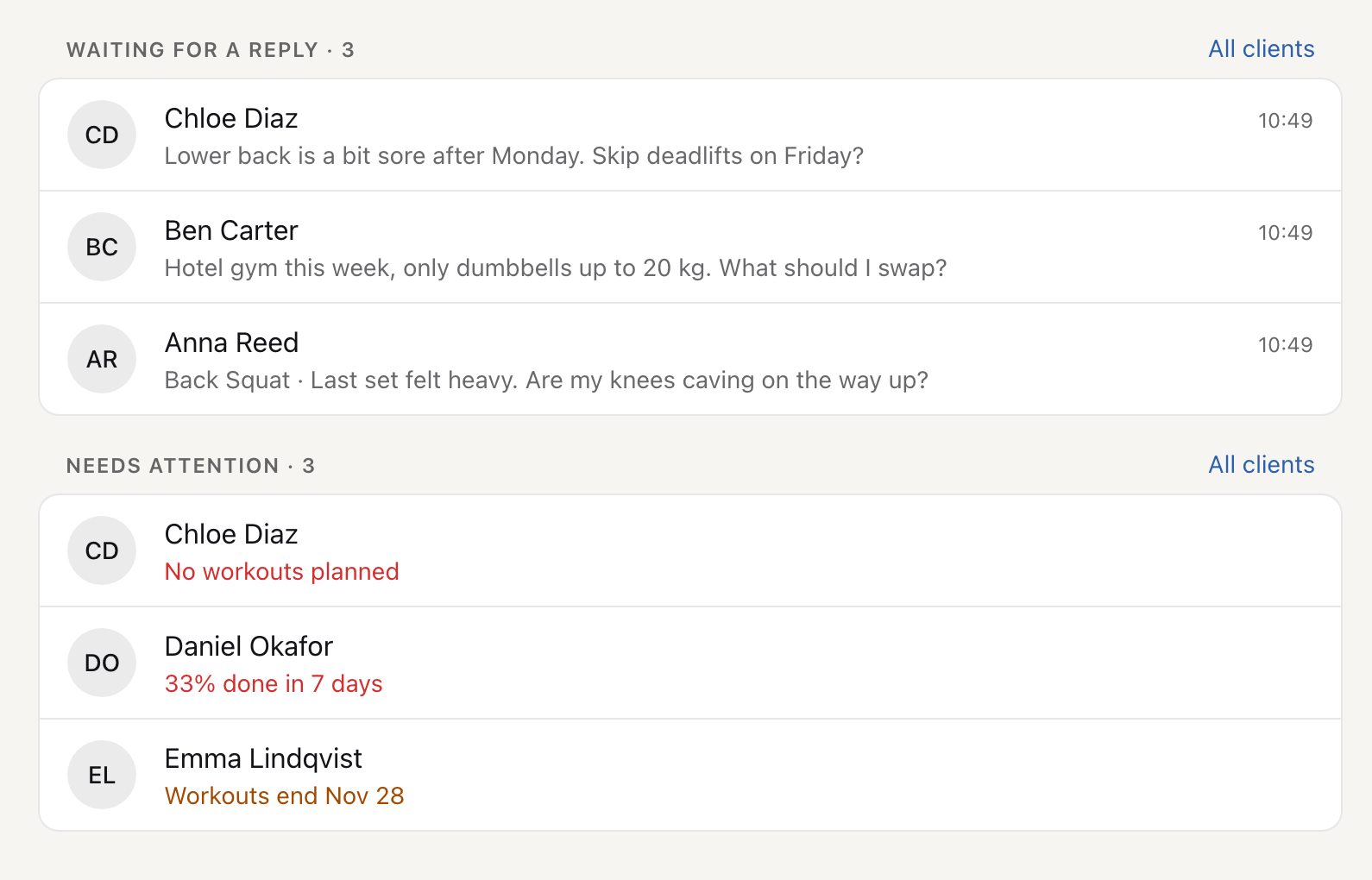
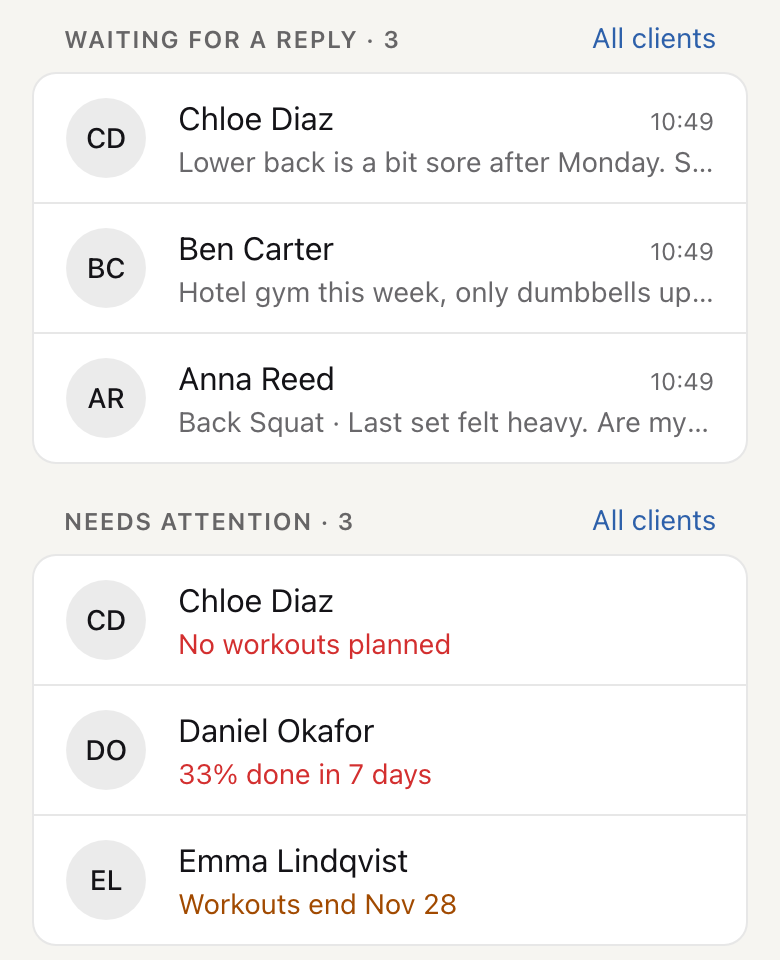
The coach’s home screen, on demo data
- 1 Waiting for a reply: every chat where a client wrote and the coach hasn’t read it yet, whether the main chat, a workout or an exercise. A row leaves when the coach opens that chat.
- 2 Needs attention: clients who did less than half their workouts in the last 7 days, whose workouts have ended or end within three days, who have none planned, or whose access has ended or ends within a week.
In OnlineFitness.app the coach’s home screen opens with these lists (after any new leads), so an unanswered message or a client who has stopped training is the first thing a coach sees in the morning.
3. Give real feedback at every check-in
35 reviews talk about check-ins, and the complaints are about check-ins with no real feedback, or none at all: sending photos and logs and getting back “you’re doing great,” or nothing. A check-in reply should name one thing from this week’s log and one thing to do next.
The strongest finding in the research sits right here. A review of 122 programs with almost 45,000 people found that self-monitoring works best when it’s combined with goals and feedback on progress. For an online coach, that’s the weekly loop: the client logs each session, you read the log, you reply. For what to look at in the log, see How to track client progress.
4. Give food guidance clients can follow
Food comes up in 45 reviews, about as often as price. Clients ask for something practical: meals that fit their week, their budget and the food they like. The complaints are about generic meal plans, recipes that ignore what the client said, or no help with food at all. In a survey of 148 personal training clients, sticking to their diet was the problem most of them found hardest.
What a coach may advise on nutrition depends on their qualifications and where they work. Where a client needs a meal plan for a medical condition, the good answer is a referral to a registered dietitian.
5. Change the plan when life changes, and say why when you don’t
31 reviews mention whether the plan moved with the client: a hotel gym on a work trip, a bad week, a plateau. Clients almost always praise it when it happens.
What surprised us is the opposite case. A plan that stays the same can read as neglect, even when it’s deliberate. In one review, a client took weeks of the same workouts as the coach not paying attention; it was planned progressive overload, but nobody had told the client. When the plan stays, write one line about why: “Same exercises this week, we add weight on the squat and keep the rest.” It costs a minute and turns “nothing changed” into “the coach has a plan.”
6. Review technique on video
25 reviews mention form feedback on videos the client sent. In the forum sample, which has more people training for strength, it’s almost always praised, and nobody complained about it. The praise is consistent: the coach watched the set, said what to change and checked again later.
There is no trial of a coach reviewing videos remotely. The nearby evidence is solid, though: supervised training with a coach present gives moderately bigger strength gains than training alone, and in a survey of 148 personal training clients, more than half ranked clear instruction and correction as the first thing they judge a trainer by. We’d keep it short and specific: one rep, one cue. The handbook chapter Feedback belongs on the rep shows how.
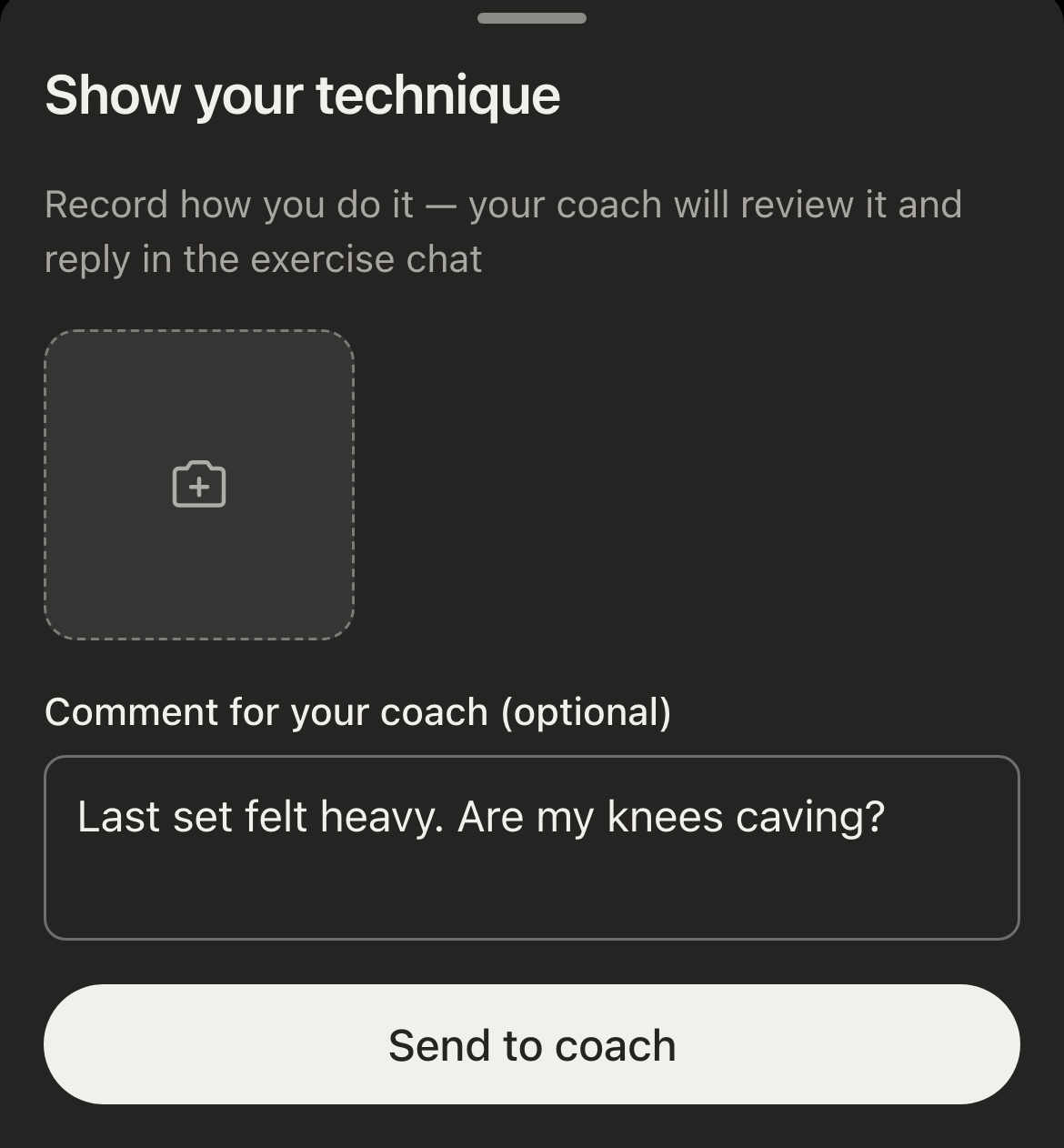
The client’s app: sending a set to the coach
- 1 In the middle of a workout the client adds a video of the set, with a comment if they want.
- 2 The video goes to the chat of that exercise, where the coach replies. In the mobile app, the upload keeps going if the client leaves the app.
7. Notice when a client goes quiet
18 reviews praise a coach for noticing missed workouts, or blame one for not noticing. It matters because dropping out is the default: in a study of 5,240 new gym members, 63% had stopped coming before their third month.
Write after the first missed session, not the third missed week: “Saw Tuesday didn’t happen. Shorter session this week?” The chapter Why clients ghost in week 3 explains why clients drop off in week three.
8. Take injuries and health seriously
24 reviews are about how the coach handled an injury, a health condition or an eating disorder history. When the coach adapted, cutting the load, swapping an exercise, training around a sore back, clients are grateful. When the coach ignored it, the review is among the angriest we read.
Reviews of exercise programs for older adults and people with chronic conditions list an early look at what stands in the client’s way among the factors that keep people training. Ask about health before the first program, ask again when something changes, and know when to send the client to a doctor, physical therapist, dietitian or mental health professional instead.
9. Explain the why, and don’t shame
17 reviews talk about whether the coach explained why the plan looks the way it does; most praise a coach who did, so the client learned something they could keep. 30 talk about tone: encouragement without pressure, or the opposite.
This is the best-studied trait on the list. Dozens of studies find that people who feel they chose to exercise, feel capable and enjoy it are more likely to keep going, and trials show that coaching which gives choices and explains its reasons can build that.
Why clients leave an online coach
Some things come up rarely, but almost always as a complaint. The table counts the reviews that complain about each.
| What happened | Reviews |
|---|---|
| Hidden fees, lock-in contracts, refund fights, a pitch the coaching didn’t match | 20 |
| Handed to a different coach without warning | 12 |
| Copy-pasted, pre-recorded or AI-sounding messages | 10 |
| Coach went silent after the payment | 5 |
| Coach visibly had too many clients | 4 |
Price on its own rarely made anyone angry. Price next to a template and slow replies did. The money complaints are mostly about how it was sold: a price revealed only on a sales call, a contract that was hard to leave, fees nobody mentioned. Clear pricing and a clear way out are part of good coaching; the handbook chapter Getting paid without chasing covers the setup.
Automated and AI-written messages are a newer complaint. Clients notice copy-pasted check-in replies and pre-recorded voice notes, and some call the whole service a scam because of it. Tools that save time are fine; a reply that could have gone to anyone is not.
Can an app do the coach’s job?
For a while, at least in weight-loss trials. In a 2006 trial, automated feedback matched a human counselor at three months; at six months the people with a human had lost 7.3 kg (16 lb), against 4.9 kg (10.8 lb) with automated feedback. The 2024 trial above found the same: the app alone was not as good as the app with a coach. Standalone fitness apps show small effects, not statistically significant, that fade after about three months.
Online coaching itself holds up well. In a 2025 trial with trained adults, people kept to 88% of sessions with an in-person coach, 81% with app-guided online coaching and 52% with a PDF plan. The in-person group gained more squat strength. In sessions kept, the gap between a coach in an app and a PDF is much bigger than the gap between online and in person.

A quick self-check
Seven questions to ask about your own coaching this week:
- Could any of my clients’ plans be swapped with another client’s without anyone noticing?
- Do my clients know when I reply, and did I keep to it this week?
- Is there a client whose plan hasn’t changed for a month without a word from me about why?
- Did every technique video a client sent me get a specific reply?
- Who missed a session last week, and did I write to them?
- Do I know each client’s injuries and health limits, and when I last asked?
- Would a client be surprised by anything on their next invoice?
What this data doesn’t tell you
- How many clients are happy. Reviews come from people with strong feelings, and we read low ratings on purpose to see complaints. The good-to-bad ratio in our sample means nothing.
- What works for every client. The review site sample is mostly UK and Ireland, mostly weight loss; the forum sample leans to strength training in the US. Other markets and goals may differ.
- Reply time, video review and check-in frequency in numbers. No study we found tests them directly.
- Whether the reviews are true. They are unverified public posts, and some businesses dispute them.
Methodology
Reviews. In November 2026 we searched for first-person accounts by clients of online or remote fitness coaches, in English. 99 come from a public review site, about ten online coaching businesses; we read 1–3 star reviews on purpose so complaints were not drowned out by five-star ones. The other 72 come from strength and fitness forums, a tech forum, a parenting forum, media reviews by people who tried a service, and two complaint sites. We kept only people describing their own experience as a client, not coaches, and dropped duplicates. One large discussion site blocked our tools and is not in the sample.
Coding. Each review got a short summary and one or more topic codes, built from the reviews themselves rather than from a list made in advance. AI tools helped collect and code the reviews. We then checked a random sample against the live pages and corrected the counts. We don’t name the businesses or the reviewers.
Check. We opened 40 randomly chosen reviews again on the live pages. 36 could be opened: 28 matched their summary and codes, 4 had small inaccuracies and 4 had real errors. We removed two posts whose authors were not clearly clients and one review that doesn’t say the coaching was online, and dropped one topic code the review didn’t support. That left 171 reviews. Some forum pages in the sample show no text to our tools, so those reviews remain in the sample unchecked.
Studies. We looked for meta-analyses, randomized trials and large surveys on coach behavior, adherence, remote coaching and dropout, and read 34 of them, at least the abstract and often the full text. One paper under an editor’s expression of concern was left out. The table lists the ones this article relies on.
| Study | What it found |
|---|---|
| Fisher et al. (2022), meta-analysis of 12 studies | Supervised resistance training gave a moderate strength benefit over unsupervised; body composition barely differed. |
| Gavanda et al. (2025), randomized trial, 79 adults | Sessions kept: 88% in-person coaching, 81% app-guided online coaching, 52% PDF plan. |
| Tate et al. (2006), randomized trial, 192 adults | Automated feedback matched a human counselor at 3 months; at 6 months −7.3 kg with a human vs −4.9 kg automated. |
| Spring et al. (2024), JAMA, randomized trial, 400 adults | Weekly coaching calls added to an app: −4.8 kg vs −2.8 kg with the app alone at 6 months. |
| Damschroder et al. (2020), randomized trial, 357 adults | Up to three coaching calls a year added to an app made no difference to activity. |
| Michie et al. (2009), meta-regression, 122 evaluations | Self-monitoring worked best, and better still with goal setting and feedback on progress. |
| Greaves et al. (2011), review of 30 reviews | Programs worked better with more frequent contact, social support and self-monitoring. |
| Teixeira et al. (2012), review of 66 studies; Ntoumanis et al. (2021), meta-analysis of 73 | Feeling of choice, competence and enjoyment predicts sticking with exercise; coaching that supports them helps. |
| Collado-Mateo et al. (2021), umbrella review of 55 reviews | Supervision, early assessment of barriers, feedback and progress monitoring among the factors linked to adherence. |
| Hao et al. (2023), meta-analysis of 18 studies; Morgan et al. (2016), review of 33 | Tailored messages beat generic ones by a small margin; participants name personalized sessions as a reason to stay. |
| Ćurović and Grečić (2023), survey of 148 personal training clients | 55% ranked clear instruction, demonstration and correction first when judging a trainer. |
| Sperandei et al. (2016), 5,240 new gym members | 63% stopped before their third month. |
| Romeo et al. (2019), meta-analysis of 9 trials | Standalone fitness apps: small, non-significant effect, strongest in the first 3 months. |
Fisher et al. (2022), meta-analysis of 12 studies
- What it found:
- Supervised resistance training gave a moderate strength benefit over unsupervised; body composition barely differed.
Gavanda et al. (2025), randomized trial, 79 adults
- What it found:
- Sessions kept: 88% in-person coaching, 81% app-guided online coaching, 52% PDF plan.
Tate et al. (2006), randomized trial, 192 adults
- What it found:
- Automated feedback matched a human counselor at 3 months; at 6 months −7.3 kg with a human vs −4.9 kg automated.
Spring et al. (2024), JAMA, randomized trial, 400 adults
- What it found:
- Weekly coaching calls added to an app: −4.8 kg vs −2.8 kg with the app alone at 6 months.
Damschroder et al. (2020), randomized trial, 357 adults
- What it found:
- Up to three coaching calls a year added to an app made no difference to activity.
Michie et al. (2009), meta-regression, 122 evaluations
- What it found:
- Self-monitoring worked best, and better still with goal setting and feedback on progress.
Greaves et al. (2011), review of 30 reviews
- What it found:
- Programs worked better with more frequent contact, social support and self-monitoring.
Teixeira et al. (2012), review of 66 studies; Ntoumanis et al. (2021), meta-analysis of 73
- What it found:
- Feeling of choice, competence and enjoyment predicts sticking with exercise; coaching that supports them helps.
Collado-Mateo et al. (2021), umbrella review of 55 reviews
- What it found:
- Supervision, early assessment of barriers, feedback and progress monitoring among the factors linked to adherence.
Hao et al. (2023), meta-analysis of 18 studies; Morgan et al. (2016), review of 33
- What it found:
- Tailored messages beat generic ones by a small margin; participants name personalized sessions as a reason to stay.
Ćurović and Grečić (2023), survey of 148 personal training clients
- What it found:
- 55% ranked clear instruction, demonstration and correction first when judging a trainer.
Sperandei et al. (2016), 5,240 new gym members
- What it found:
- 63% stopped before their third month.
Romeo et al. (2019), meta-analysis of 9 trials
- What it found:
- Standalone fitness apps: small, non-significant effect, strongest in the first 3 months.
Links: Fisher 2022, Gavanda 2025, Tate 2006, Spring 2024, Damschroder 2020, Michie 2009, Greaves 2011, Teixeira 2012, Ntoumanis 2021, Collado-Mateo 2021, Hao 2023, Morgan 2016, Ćurović 2023, Sperandei 2016, Romeo 2019.
How to cite this research
Kulakov, A. (2026). How to be a good online fitness coach: what 171 clients and 34 studies say. OnlineFitness.app. https://onlinefitness.app/articles/how-to-be-a-good-online-fitness-coach. Published November 26, 2026; n = 171 client reviews and posts, read November 2026.