Back extension bench
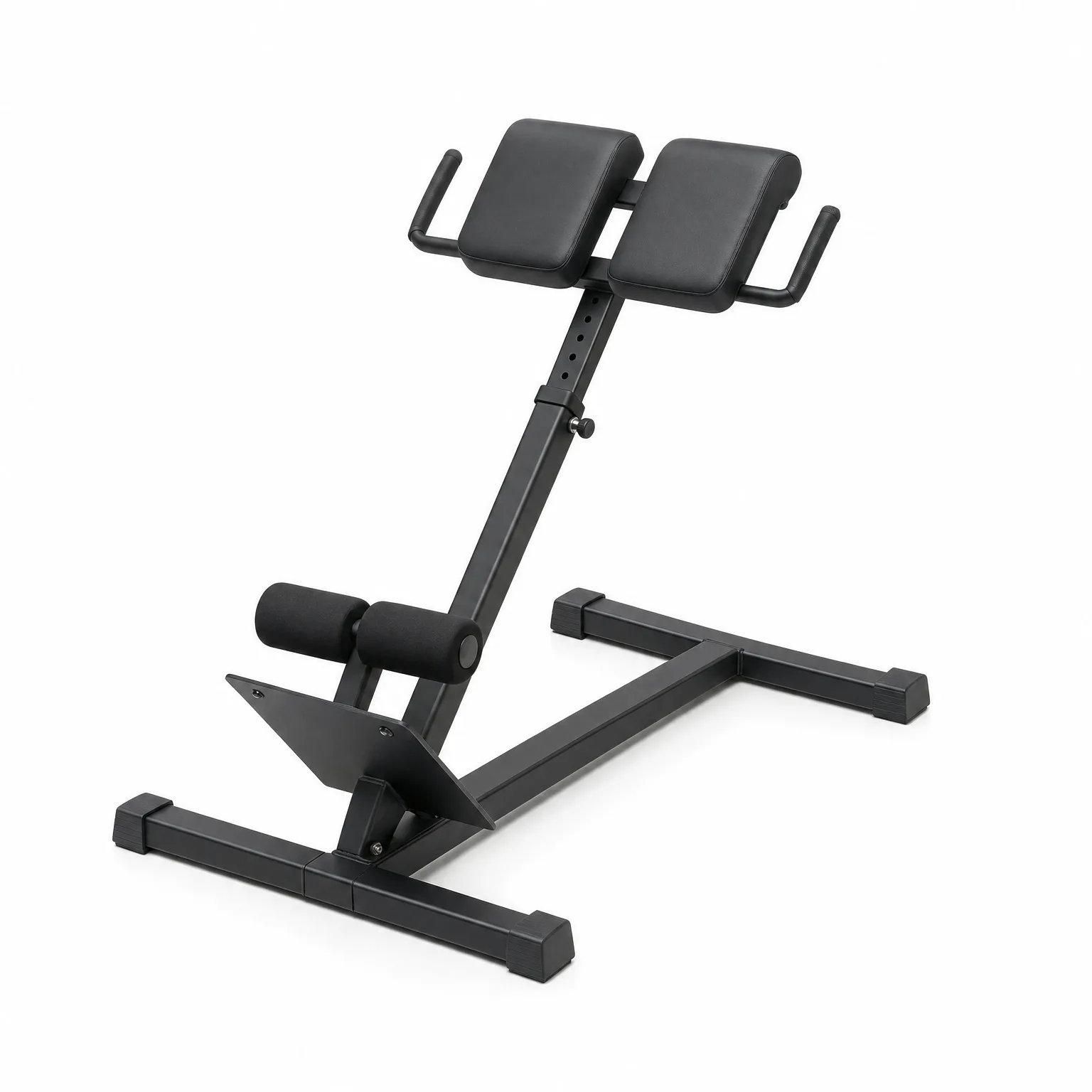
A padded hip support with ankle rollers. You hinge forward and lift the torso to train the lower back, glutes and hamstrings.
In short
A back extension bench, also called a Roman chair or hyperextension bench, holds your ankles under rollers and supports the front of your hips or thighs on a pad. From there you bend forward at the hips and lift the torso back up. It trains the lower back, glutes and hamstrings with body weight, or with a plate held at the chest.
It suits beginners, since the movement is simple and the load starts light, and it stays useful for advanced lifters who add weight. Most benches are angled at 45 degrees. Some hold the body horizontal, which is harder.
- Category
- Gym machines
- Where
- Gym, Home
- Level
- Beginner and up
- Space
- Needs a dedicated area
- Typical sizes
- A 45° bench takes about 1.3 x 0.7 m (4.5 x 2.5 ft) of floor; a horizontal Roman chair is longer, about 1.5 m (5 ft)
- Also called
- roman chair, hyperextension bench, back extension machine, hyperextension machine, 45 degree hyperextension, back raise bench, hyper bench
Muscles it works
- Main
- Lower back, Glutes, Hamstrings
What it is used for
- Back extensions for the muscles along the spine
- Hip extensions with a flat back for the glutes and hamstrings
- Side bends lying on one hip for the obliques
- Holding the top position for time to build endurance in the back of the body
- Weighted extensions with a plate or dumbbell at the chest
Types
45° hyperextension. The body leans at 45 degrees. The rep is hardest in the middle, where the torso passes horizontal, and eases toward the top. Easier to get on and the usual choice for beginners.
90° Roman chair. The legs are horizontal and the torso hangs straight down at the bottom. Gravity works hardest when the body is level, so the top of the rep is the heaviest part.
Adjustable-angle bench. The angle of the bench changes in steps, on some models all the way to horizontal. Common in home models, which often fold.
Glute-ham developer. A larger relative with a rounded pad and a footplate. It adds glute-ham raises, where the knees bend as well. Much harder.
How to choose
Set the pad height for the hip
Adjust the pad so its top edge sits just below the hip crease, on the upper thighs. Your hips must be free to fold over it. If the pad covers the hip bones or the stomach, you cannot hinge and the lower back has to bend instead.
Fix the ankles
Stand on the footplate with the backs of the lower legs, just above the heels, under the rollers. If the rollers adjust, set them so the legs are held without the knees locking hard. The feet stay flat on the plate.
Pick the angle
Start on a 45‑degree bench if you have the choice. Move to a horizontal bench, or add load, when 15 body-weight reps are easy.
Add weight in small steps
Hold a plate or dumbbell against the chest with crossed arms. Start with 2.5–5 kg (5–10 lb). Holding the weight behind the head or at arm's length makes the same weight feel much heavier.
How to start using it
- Get on and set a straight line. Step onto the plate, hook the ankles and lean onto the pad. Cross the arms over the chest. At the top, the body forms one straight line from ankles to head.
- Hinge down. Bend at the hips and lower the torso in two to three seconds as far as you can with control. Keep the neck in line with the spine.
- Lift to a straight line and stop. Squeeze the glutes and raise the torso until the body is straight again. Do not swing higher into an arch. Pause for a second.
- Choose the emphasis. For glutes and hamstrings, keep the back flat or the upper back slightly rounded, turn the feet out a little and think of pushing the hips into the pad. For the lower back, let the spine round gently on the way down and straighten it on the way up, with a light load.
Common mistakes
Pad too high
With the pad on the stomach or hip bones the hips cannot fold. The range shrinks and all the bending happens in the lower back. Lower the pad to the top of the thighs.
Arching past straight at the top
Throwing the torso up into a deep arch loads the lower back at the end of its range on every rep and adds nothing for the glutes. Finish in a straight line.
Swinging the reps
Dropping fast and bouncing back up uses momentum. Lower for two to three seconds and pause at the top.
Adding weight too early
Holding a heavy plate before body-weight reps are controlled usually shortens the range and speeds the reps up. Earn the load with 15 clean reps first.
What to use instead
A glute-ham developer (GHD) allows the same back extension with the body horizontal. At home, lie face down over a fitball with the feet braced against a wall and do the same movement. On a mat, supermans and bird dogs train the lower back with no equipment. Romanian deadlifts and good mornings with dumbbells load the same muscles standing.
-
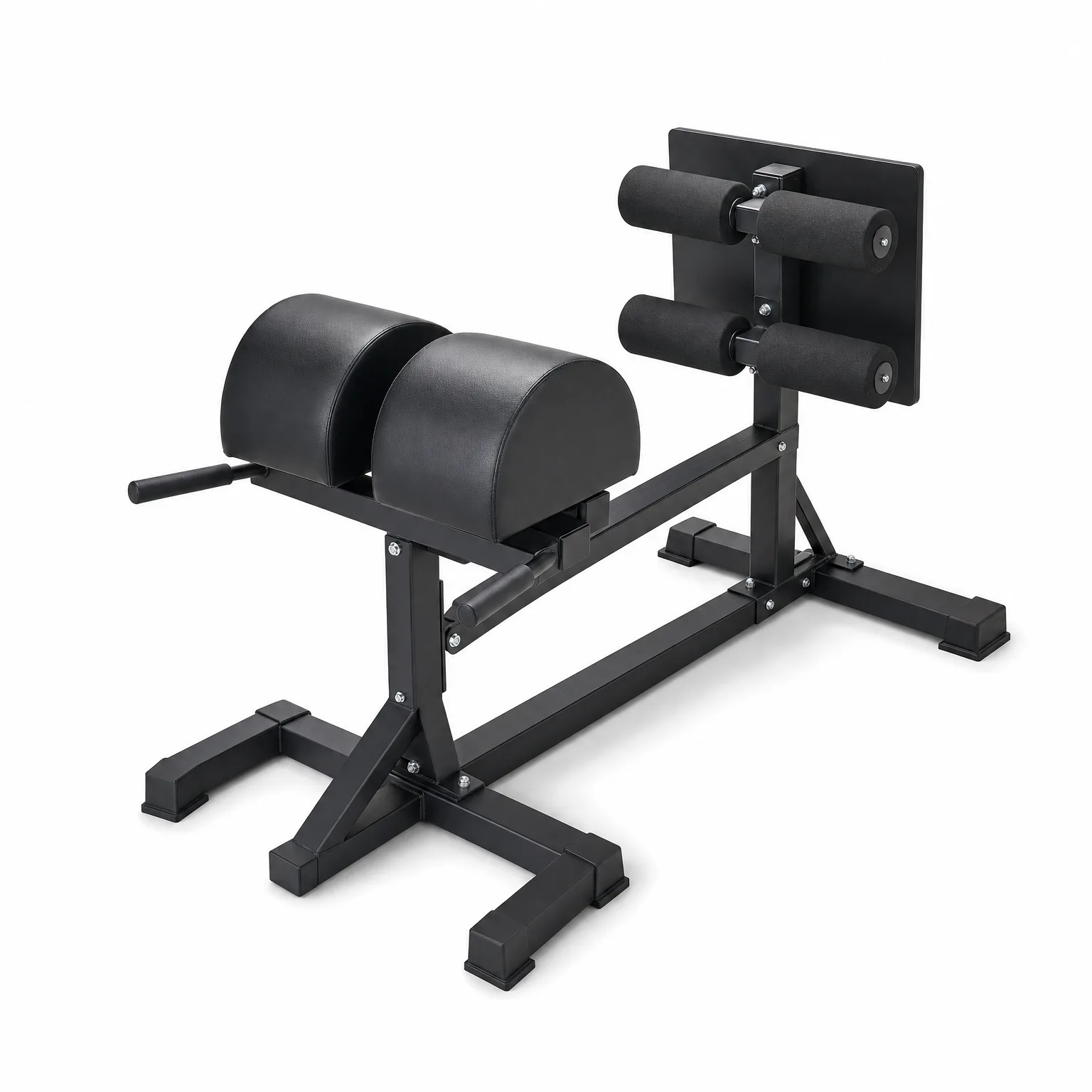
Glute-ham developer
A bench with a rounded pad, foot rollers and a footplate, used for glute-ham raises, back and hip extensions and GHD sit-ups. -
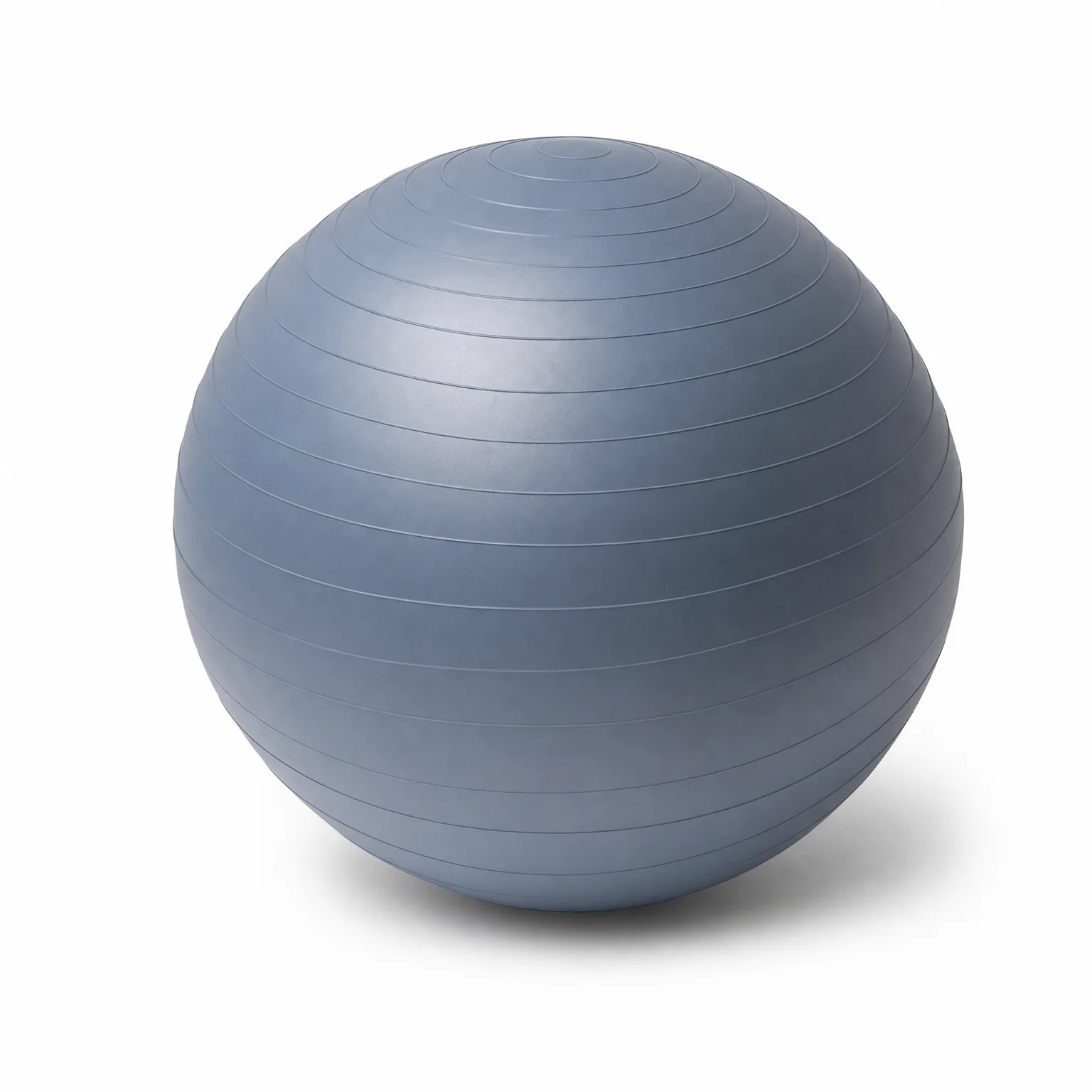
Stability ball
A large inflatable ball you sit, lie or lean on. The unstable surface is used for core exercises, hamstring curls and supported stretches. -

Dumbbells
A pair of short handles with a weight at each end. One pair trains every major muscle group, at home or in a gym. -

Exercise mat
A cushioned, non-slip surface for floor exercises, stretching and yoga. The first thing most people need to train at home.
Often used with
Questions about back extension bench
What muscles does the back extension bench work?
The muscles along the spine, the glutes and the hamstrings. How you perform it shifts the emphasis: a flat or slightly rounded upper back with a strong glute squeeze favors the glutes and hamstrings, while letting the spine bend and straighten favors the lower back muscles.
45‑degree or 90‑degree back extension: which is better?
The 45‑degree bench is easier to get on and lighter at the top of the rep, so it is the better start. The horizontal Roman chair is hardest at the top, where the body is level. Both train the same muscles. Use whichever you have and progress by adding reps, then load.
Is a Roman chair the same as a hyperextension bench?
In everyday use, yes. Both names describe a bench that holds the ankles and supports the hips for back extensions. Some people use Roman chair only for the horizontal version and hyperextension bench for the 45‑degree one.
How many back extensions should I do?
Two or three sets of 10–15 controlled reps, two or three times a week, is a common starting point. When 15 reps are easy, hold a light plate at the chest instead of adding more reps.
Build programs around what your client has
This guide comes from OnlineFitness.app, the app online coaches run their clients in.
Free for life for the first 100 coachesNo card